Hands-on with Tencent Hy-MT2 1.8B Q4_K_M (1.08GB) on M1 Max 64GB via llama-server. JSON, SRT, HTML, glossary, and minority-language prompts with full input-output pairs. The 1.25bit 440MB build does not load on stock llama.cpp 8990, and 30B-A3B (hy_v3) is not in the Mac route yet.
Ran WAI-Anima v1.0 with a custom character LoRA on an M1 Mac to see if 2- and 3-character compositions actually hold up. Notes on what breaks and what holds at different LoRA weights, with practical settings that stay stable.
On M1 Max 64GB, SetLatentNoiseMask returns unchanged images with no error. LanPaint alone takes 32 min; adding Crop-and-Stitch drops text inpaint to 2:31.
Tested on M1 Max: Floyd-Steinberg halftone + BLE pacing + a vendor-specific density command `1D 49 F0 nn` to print sharp photos on the Sugar YMP-01 thermal mini printer from Python.
Tested on M1 Max: switching a Python BLE client to RFCOMM (SPP Ch.2) cuts transfer from ~60s to 5.38s for a 140KB JPEG. Covers PyObjC quirks, macOS Bluetooth entitlement, and an isolation experiment confirming olie.xdev's 'possibly not required' steps.
Tested Klein 9B + 9B NSFW LoRA on M1 Max 64GB via mflux 0.17.5: 1m51s/512, 5m37s/1024 q4, 224/224 LoRA keys match, NSFW prompts uncensored, Japanese subjects work with helper tokens.
Klein 4B / 9B / Base LoRAs aren't cross-compatible — a 9B NSFW LoRA throws 'lora key not loaded' on mflux's 4B path. The variant map, what mflux runs today, and where the working hands-on test lives.
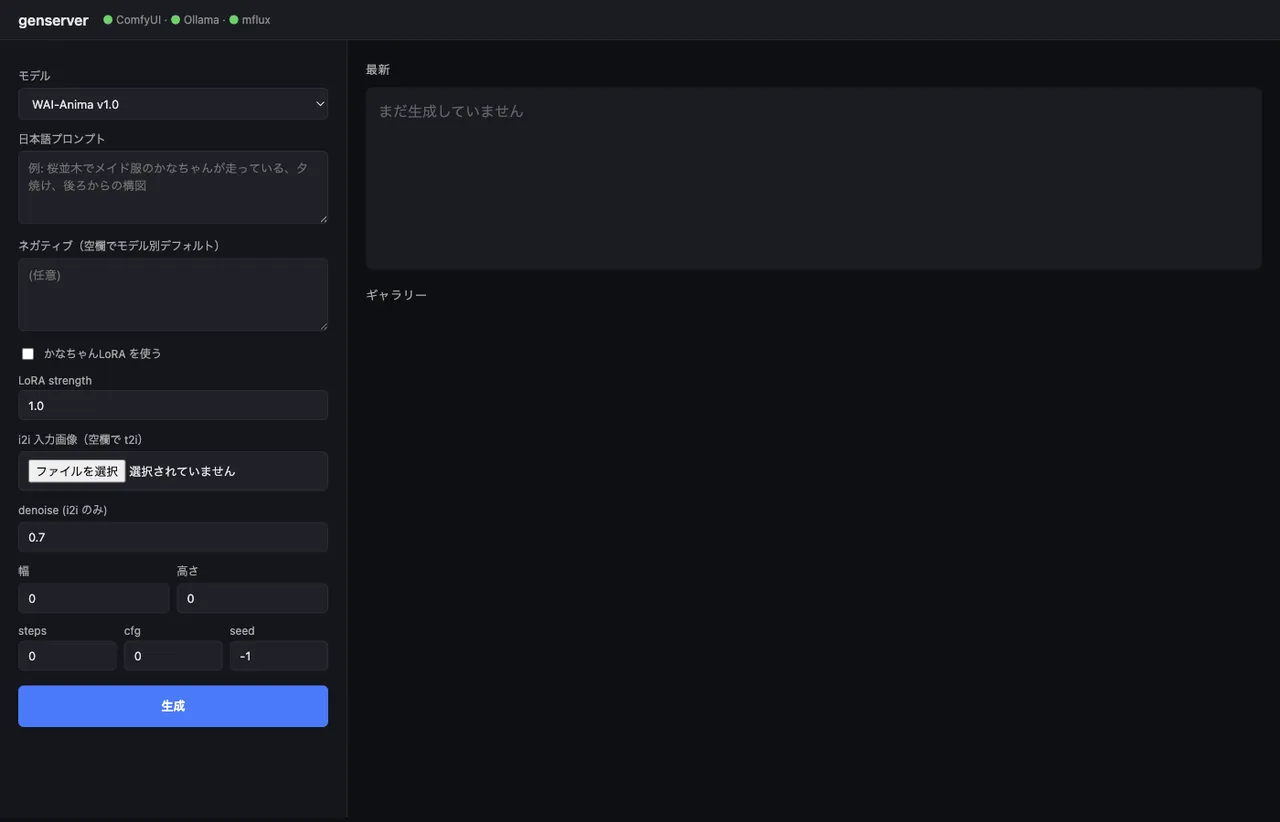
Three local image generation engines (WAI-Anima, WAI-IL/SDXL, FLUX.2 Klein 4B) tied together by a thin FastAPI wrapper that takes Japanese prompts. Ollama (gemma3:12b) handles JP→EN, ComfyUI workflows are built on the fly in Python, FLUX.2 runs as an mflux subprocess, and the whole thing is reachable from an iPhone over Tailscale.
Pruna AI's FP8 speedup needs compute capability 8.9, so Apple Silicon is out. Measured what M1 Max 64GB actually does with MLX-based mflux and antirez's iris.c: install traps, real generation times, and a wrapper kit to skip the setup.
Set up the CLI version of NDLOCR-Lite on Apple Silicon Mac, then tested OCR result correction with Qwen 3.5 and Swallow. Includes experiments with direct image reading and the anchoring effect.
Went 0-for-13 trying to train an Illustrious-XL LoRA on a Mac Studio M1 Max 64GB. With help from multiple AI agents, pinpointed the root causes and finally succeeded on a RunPod RTX 4090. The full record: three fatal parameters and the sd-scripts trap.