AWS Strands harness benchmarked against Claude Code and Codex on identical models using official data. Covers cost gaps, model swapping, and unprompted shell execution risks.
Tested on M1 Max 64GB: Qwen3.8-27B hits ~19 tok/s on both MLX and Ollama, but the default reasoning_effort=xhigh blew thinking up to 50,373 chars. Why Ollama dodges it.
Tested LFM2.5-1.2B-JP-202606 on M1 Max 64GB. llama.cpp Q4_K_M: 208 tok/s decode, JSON intact, model name hallucinated (LFM→FDM). Q8_0: 157 tok/s, no hallucination. Tool calls broken via GGUF.
Out-of-bounds read in Ollama's GGUF loader before 0.17.1. If your Ollama API is network-accessible, a crafted model file can exfiltrate env vars, API keys, system prompts, and conversation fragments from process memory.
Tested connecting MCP servers to Ollama local LLMs on M1 Max 64GB. MCPHost is deprecated, tool calling breaks with quantized models, and context fills fast. Includes working TypeScript and Python custom MCP server setups.
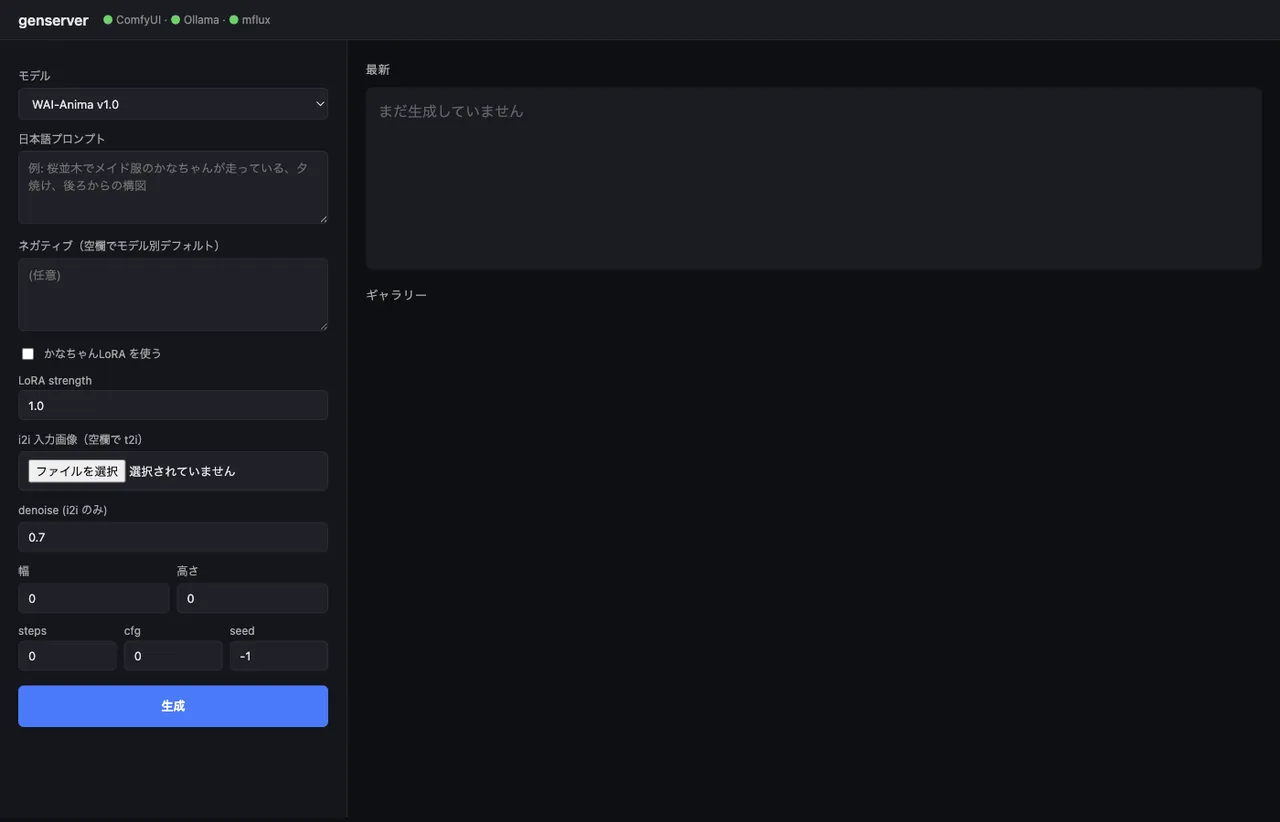
Three local image generation engines (WAI-Anima, WAI-IL/SDXL, FLUX.2 Klein 4B) tied together by a thin FastAPI wrapper that takes Japanese prompts. Ollama (gemma3:12b) handles JP→EN, ComfyUI workflows are built on the fly in Python, FLUX.2 runs as an mflux subprocess, and the whole thing is reachable from an iPhone over Tailscale.
Hands-on log of building the DEV article's PDF RAG on M1 Max 64GB, extending it with images via CLIP, and pushing through Japanese with bge-m3 + Qwen3.6 35B. Documents the modality gap, the dual inference server crash, and LLM-jp 4-8B's empty chat template silently dropping the system role.
The NotebookLM clone open-notebook assumes Docker and cloud APIs by default. I installed SurrealDB natively, ran four processes in tmux, and wired everything through Ollama's qwen3.6:35b and bge-m3. I fed it the Qwen3.6 benchmark article I wrote this morning, and it answered with the correct numbers.
Tried Qwen3.6-27B on both Ollama and MLX. Ollama couldn't load the VL-projector-embedded GGUF, MLX ran it at 11 tok/s. On the side, running 35B-A3B under MLX was roughly 2× faster than the Ollama GGUF. Also had both models build a BBS to gauge intent handling.
Hands-on Qwen3.6-35B-A3B (23GB 4bit GGUF) on M1 Max 64GB via Ollama 0.20.6. Generation speed stays at 27 tok/s — same as Qwen3.5-35B-A3B — but the same prompt produces 13× more thinking tokens. Multi-turn behavior, persona handling, and a three-tier NSFW probe included.
Running local models and still getting refusals? LLM safety stacks five layers: input filter, system prompt, RLHF, Constitutional AI, output filter. Where abliterated and uncensored variants cut, and which blocks survive on Gemini, Claude, and local LLMs.
I tested local Vision LLMs (Gemma 3, Qwen2.5-VL, Llama 3.2 Vision, Gemma 4) to see if they could look at character illustrations and pixel art and generate RPG-style stats in JSON format.