Tested on M4 Mac mini: Gemini 4 Argon availability in AGY, pricing comparison, and CLI benchmark runs between GPT-6.1 Sol, Claude Opus 5.5, and Gemini 3.8 Flash.
AWS Strands harness benchmarked against Claude Code and Codex on identical models using official data. Covers cost gaps, model swapping, and unprompted shell execution risks.
Tested Qwen3-Embedding and Qdrant memory on a StackChan voice chat server. Ramen and guitar were recalled, but weekend plans hovered right at the 0.45 threshold.
How do 6 open-source Jev clones compare under code inspection? We examine implementations using ModernBERT, Qwen, and diffusion models across state sharing, question isolation, and scoring trade-offs.
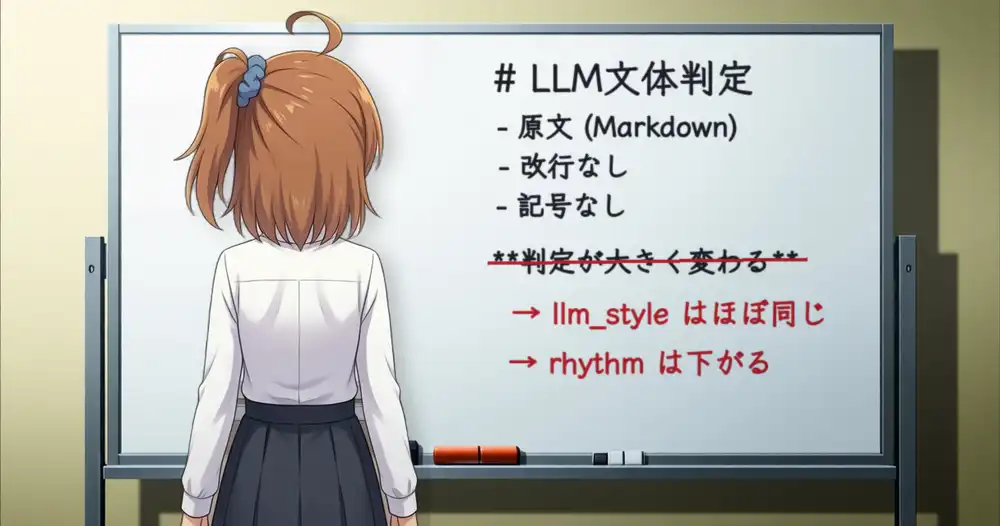
We tested TypeSafe AI's Jev across raw Markdown, stripped newlines, and plain text to examine whether LLM style scores shift. Even across multi-model rubrics from Claude, Gemini, and Qwen, the gap remained remarkably consistent.
Vals AI reported that Claude Fable 5.1 cracked Urquhart's 370-year-old Cyphral Distich. However, primary 1653 texts show the cipher is missing and extraction is impossible.
TypeSafe AI unveiled Jev, a System 1 decision model running single-pass parallel sampling in 70-500ms. $0.042/1M input tokens, free output, and RLCD calibration.
MITRE added CWE-1427 for improper neutralization in LLM prompting. Why SQLi-style escaping fails on natural language, and how Dual-LLM and guardrails stop attacks.
Tested with 16 memories and 10 questions: a date bonus on cosine got the 9/9 memory and a 0.441 café-au-lait memory over the 0.45 cutoff, with 0.016 headroom left on hit-free questions.
Ryzen 7 5800HS test before StackChan: subject-less memories got claimed by the character, a 0.45 cosine threshold flipped on a comma, and ModelScope's embedding API vanished mid-test.
McCoy, Soulos, Linzen and Smolensky swap every GPT-OSS input-token hidden state for a closed-form tensor product formula; accuracy drops at most 2.36 points and 31 causal interventions average 0.903.
LEWM predicts a 7-class emotion label for the human on screen, not a state of its own. Its 45.72% is a cosine-similarity delta vs WorldGPT, and 'self-aware' never appears in the paper.