FLUX 3 Image Klein on M1 Max: 160s T2I, BFL Sample Reproduced
 Contents
I ran the distilled version of FLUX 3 Image Klein, released by Black Forest Labs on October 15, on an M1 Max Mac with 64GB of memory. The first reproduction attempt used the upsampled English prompt and seed 1 from BFL’s fashion sample, yet produced a different person and a differently shaped coat.
I then compared the standing portraits and dynamic scenes from the April WAI-Anima comparison and the garden, portrait, and anime images from the FLUX.2 Klein 4B hands-on test. The past images were not regenerated.
Downloading the weights failed at first, but after confirming I had agreed to the terms of use on the distribution page, the retry went through.
The Model and This Test’s Settings
| Item | Details |
|---|---|
| Developer | Black Forest Labs |
| Release date | October 15, 2026 |
| Weights used | FLUX 3 Image Klein distilled BF16 |
| Image generation Transformer | 5.6B parameters. Does not include the text encoder |
| Text encoder | Qwen3-VL-4B-Instruct |
| License terms | Requires agreeing to the terms of use on Hugging Face |
| Uses | text-to-image, image editing, generation with up to 10 reference images. This test used at most 1 reference image |
“Weights” here means files containing the model’s learned numerical parameters. “Klein” is part of the model name, and 5.6B means the image generation Transformer has about 5.6 billion parameters. The distilled version reduces the number of iterations needed at generation time, and “steps” is the number of those iterations. Guidance (CFG) controls how strongly the output follows the text. The prompt upsampler is a separate model that turns a short instruction into a long description including composition and lighting, and it runs before image generation.
BF16 is the numeric format for the weights, and MPS is the mechanism for using Apple’s GPU from PyTorch. The text encoder processes the English text, the image generation Transformer iteratively updates a compressed image representation, and the VAE decodes it into pixels. The seed is the value that sets the starting point of the random numbers used in generation.
The official model card separates the settings: the distilled version uses 16 steps with no guidance, while the training-oriented Base uses 50 steps with guidance 3.5.
It also recommends sending a scene description that covers on-screen placement, materials, lighting, and background rather than a short instruction as-is. The official reference implementation uses a prompt upsampler based on a separate 9B model by default. The model card explicitly says not to use the image model without an upsampler. For the first runs I skipped it and entered hand-written English scene descriptions directly. In the latter half I also generated portraits and anime characters using the official upsampler.
Comparison Targets
| Label | Model / implementation | Role in this article |
|---|---|---|
| Anima preview3-base | Anima-family base model | Reposting the standing portrait and dynamic scene from the April article |
| WAI-Anima v1 / WAI-Illustrious v160 | Models for anime images | Likewise reposting outputs from the April article. An image made with the latter plus a character LoRA is also used as editing input |
| FLUX.2 Klein 4B / mflux and iris.c | FLUX.2 weights and two separate runtime programs for Mac | Reposting landscape, portrait, editing, and speed from the April article |
| FLUX 3 Image Klein / Diffusers and BFL reference implementation | The model and runtime library tested here | In addition to the initial conditions, regenerating the official sample, standing portrait, running scene, portraits, anime, and landscapes with the reference settings |
A LoRA is a set of additional learned parameters for a specific character or art style. Here, LoRAs were used to generate the past source images, but none were applied to FLUX 3.
Generation Conditions
I call the BFL-style noise layout, Diffusers shift 16, and FP32 VAE the “reference settings” below. Prompts are specified separately for each run, including whether the official upsampler was used. FP32 is the numerical precision used for VAE decoding.
| Item | Conditions on this Mac |
|---|---|
| Machine | MacBook Pro, M1 Max, 64GB unified memory |
| OS / test dates | macOS 27.0, October 18–19, 2026 |
| Implementation | Python 3.12.12, PyTorch 2.14.1, Transformers 5.20.1, Diffusers 0.41.0.dev0 (b800f828) |
| Device / precision | MPS using Apple’s GPU, image generation model in BF16, PYTORCH_ENABLE_MPS_FALLBACK=1. In the initial runs the VAE was also BF16; in the reference settings the VAE was changed to FP32 |
| Steps / guidance | 16 steps, the distilled version’s default. No extra CFG |
| Sampler / schedule | Diffusers’ FLUX 3 modular pipeline. The initial shift was 6.93. The first fashion comparison changed only shift to 16. Later reference-setting runs also matched the noise layout and FP32 VAE |
| Resolution | BFL’s fashion sample and subject variations at 832×1248; standing portrait, dynamic scene, Kana-chan background edit, and NSFW at 832×1216; everything else at 1024×1024 |
| Random seed | Seed 42 for the standing portrait, dynamic scene, garden, editing, layout, and NSFW; seed 7 for the portrait and the cherry blossom park; seed 0 for the fox sample. Seed 1 for BFL’s fashion sample; the rainy café and teal background also used seeds 1 and 42 |
| LoRA | None. The Kana-chan LoRAs for Anima and Illustrious were not applied to these weights |
The portrait-oriented 832×1216 was used, as in the April article, for subjects that need the full body in frame. Gardens, realistic portraits, and the like used 1024×1024, the same as the FLUX.2 article.
Shift is a coefficient that changes how the noise amount is distributed across steps. Black Forest Labs’ reference implementation specifies alpha=16. On the other hand, Hugging Face’s Diffusers write-up and the modular pipeline used here default to a shift of 6.93. For the fashion sample comparison I set the Diffusers shift to 16 to match BFL’s value, but I have not verified that the coefficients are exactly equivalent across implementations. Images made with the default shift of 6.93 skipped the upsampler and used a different noise layout from the reference implementation, so they are not outputs from the same path as the official samples.
Each condition produced a single image. The prompt format and step count differ from the past articles, so the images lined up here cannot settle which model is better. Time was measured around the pipeline call, with torch.mps.synchronize() called before stopping the timer so asynchronous MPS work was not missed. Model download, loading, and PNG saving are not included in the generation time.
Memory values are from torch.mps.driver_allocated_memory() after generation, not peak usage. Even on the same Mac, the implementation and step count differ from the mflux and iris.c runs in the past article.
PYTORCH_ENABLE_MPS_FALLBACK=1 is a setting that lets operations not supported by MPS fall back to the CPU. I did not track which operations went to the CPU, so the speeds below are values on a Mac with this setting enabled.
Reproducing the Official Samples
I entered the snowy-forest red-fox prompt from the Diffusers introduction post at 1024×1024, 16 steps, seed 0, and the Diffusers default shift of 6.93. This run skipped the official upsampler and used a different noise layout from BFL’s reference implementation.
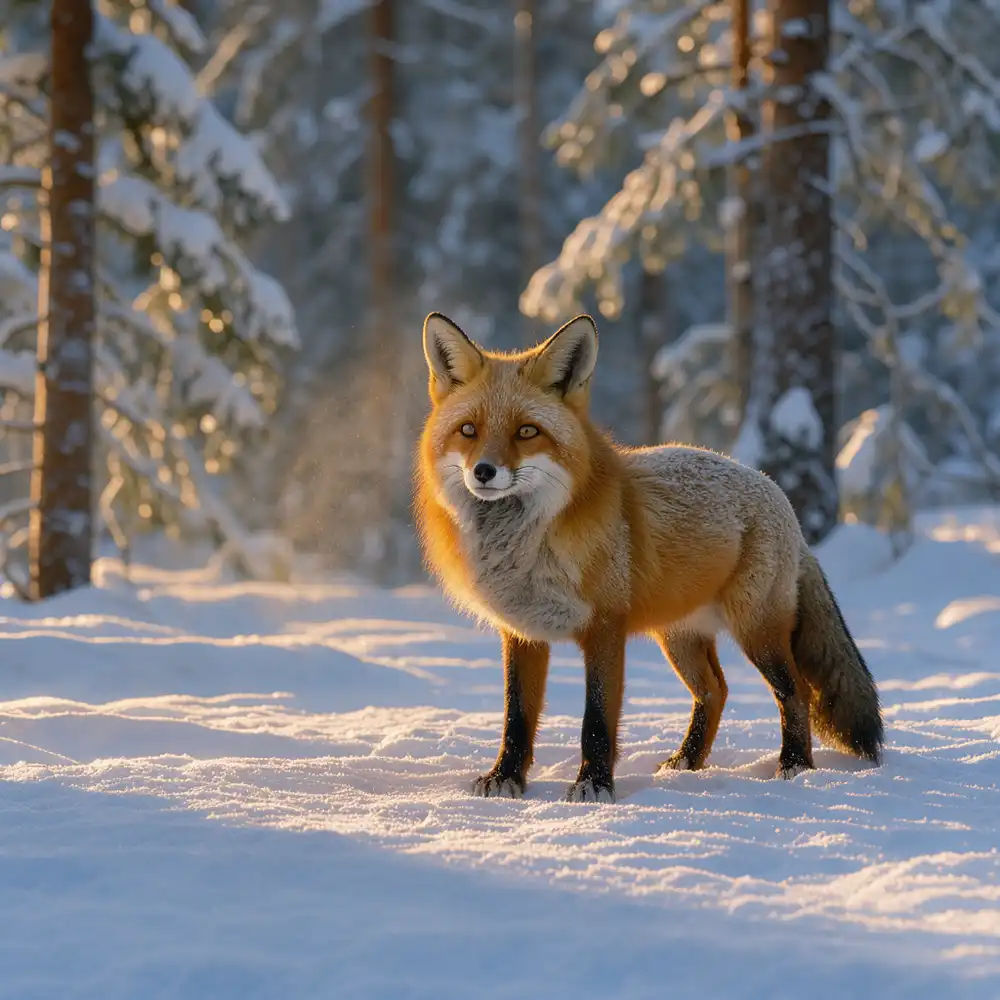
The output showed a red fox standing in a snowy forest, lit by warm light from the left. Generation took 153.45 seconds. The MPS driver allocation was 19.61GiB right after loading and 27.35GiB after generation. Swap usage observed during generation was 0. At the very least, this Mac could produce one image with the BF16 distilled version.
Official sample prompt
A wide-angle wildlife photograph of a red fox standing alert in a snow-covered forest clearing at golden hour. The fox is centered in the frame, its thick orange winter coat contrasting with the fresh white snow, breath visible in the cold air. Snow-laden pine trees fill the softly blurred background, and low warm sunlight rakes across the scene from the left, casting long blue shadows.Comparing with BFL’s Fashion Sample
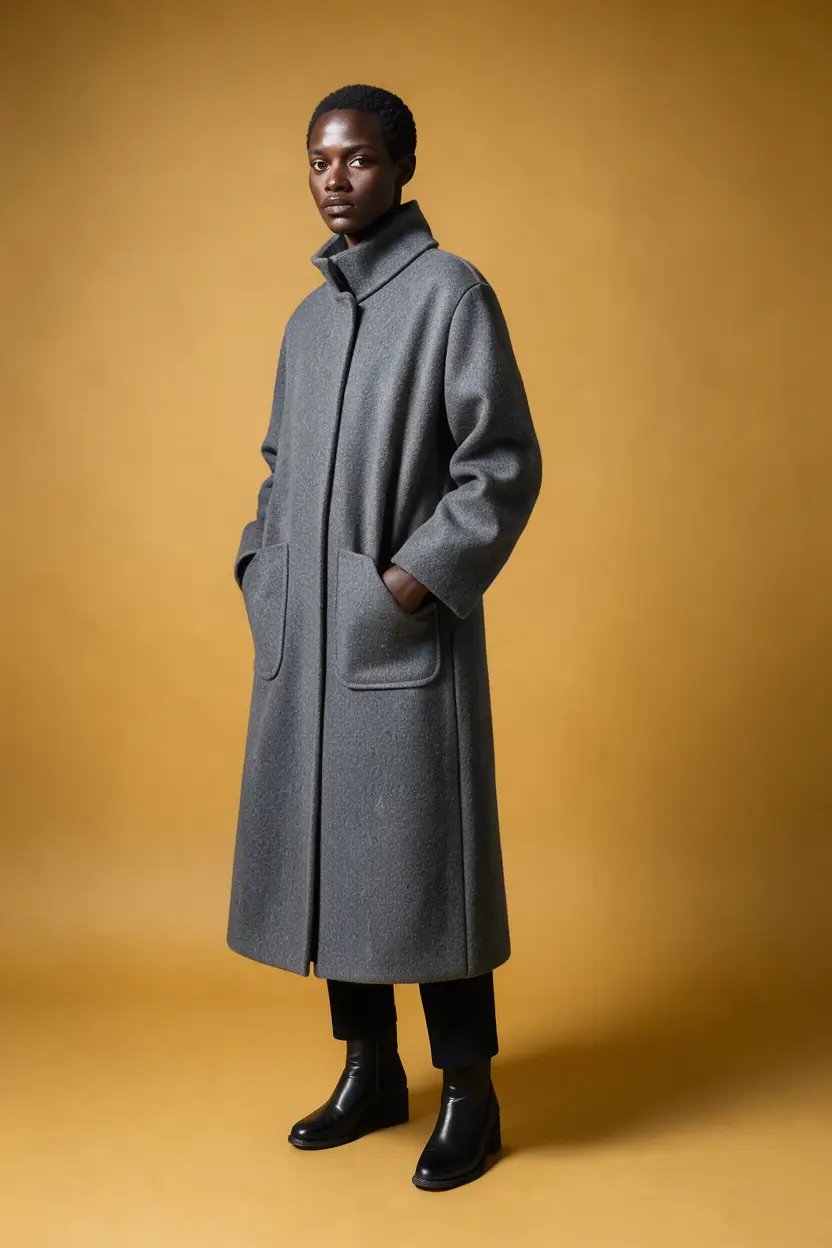
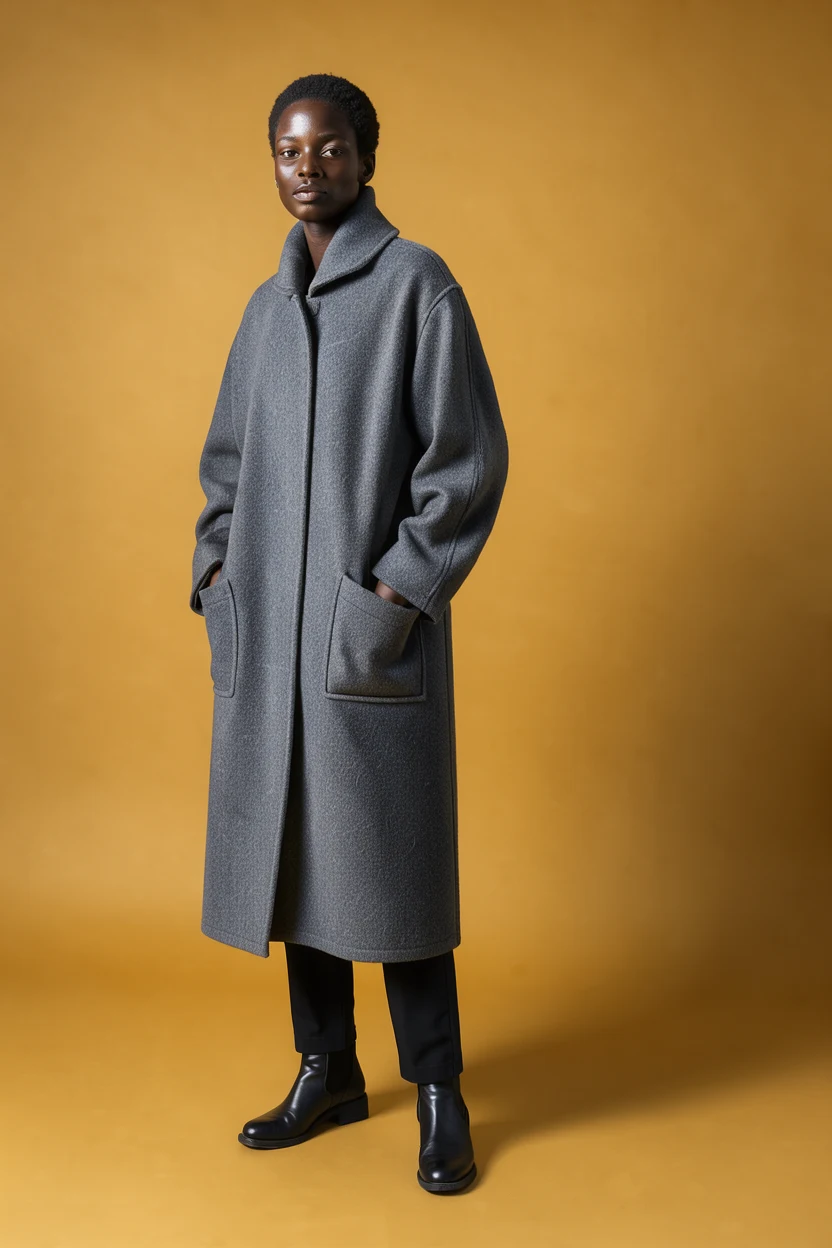
Next, I tried to reproduce the distilled version’s fashion photo sample published by BFL. From the JSON attached to the sample, I used the upsampled English prompt, 832×1248, 16 steps, and seed 1 as-is. In the first fashion comparison I changed the Diffusers shift to 16, but the result differed from the published sample down to the person’s pose and the shape of the coat.
To track down the cause, I also ran BFL’s reference implementation on MPS. I changed only the float64 in the RoPE computation, which MPS does not accept, to float32, and kept the image generation weights, prompt, seed, and step count unchanged. The reference implementation’s output had nearly the same person, pose, and outfit as the published sample.
Back in Diffusers, when I generated the initial noise in the same spatial order as BFL’s reference implementation and reran with shift 16 and an FP32 VAE, it also produced the same composition. In the first fashion comparison, the way random values were laid out across pixel positions differed from the reference implementation. However, since I changed the noise layout and VAE precision at the same time, I have not isolated the individual effect of these two factors.
| Condition | Mean absolute pixel difference from published sample | Generation time |
|---|---|---|
| First fashion comparison: Diffusers, shift 16, default noise layout, VAE BF16 | 23.90 / 255 | 163.69 s |
| BFL reference implementation, MPS | 4.44 / 255 | 144.21 s |
| Diffusers, same noise layout as reference implementation, shift 16, VAE FP32 | 4.65 / 255 | 162.60 s |
The pixel difference is the absolute difference of each RGB channel averaged over all pixels, after matching the size to the published PNG’s 832×1248. The MPS outputs are not a perfect pixel match with the published PNG, but the difference between the fixed Diffusers output and the BFL reference implementation shrank to 0.98 / 255.
Generating with the Same Noise Layout as the Official Samples
I first downloaded the BF16 files for the official reference implementation, but loading on the Diffusers side required modular_model_index.json and the weights under transformer/ and vae/. After downloading those too, the image model weights in the working directory came to about 30GiB. The Transformer and VAE are stored twice, once for the reference implementation and once for Diffusers. For the additional experiments I also downloaded the official prompt upsampler, which is about 17.5GiB.
For Diffusers alone, I should have downloaded only the files it needed from the start.
In the Diffusers implementation, I removed prompt_upsampler from the blocks of ModularPipeline.from_pretrained(...) and entered completed English captions directly. For the fashion sample I used the upsampled caption supplied in BFL’s JSON. pipe.blocks returns a separate block set each time you access it, so you edit the extracted set and then initialize the pipeline. If you get this wrong, it also tries to load the 9B upsampler, which I had not downloaded at the time. In the additional experiments I ran the official upsampler first in a separate process and passed its output text to the same image generation pipeline.
blocks = ModularPipeline.from_pretrained(model_dir).blocks
blocks.sub_blocks.pop("prompt_upsampler")
pipe = blocks.init_pipeline(model_dir)
pipe.load_components(
    names=["text_encoder", "tokenizer", "transformer", "vae"],
    pretrained_model_name_or_path=model_dir,
    dtype=torch.bfloat16,
)
pipe.to("mps")
The fox sample from the Diffusers post and BFL’s fashion sample were complete scene descriptions. I converted short prompts and tag lists from the past articles into full scene descriptions before image generation. I wrote the early ones by hand; later standing portraits and realistic portraits used the official upsampler. The hand-written English from the initial runs is not the same as either the official upsampler’s output or the prompts for the past images.
In addition, BFL’s reference implementation generates random values in the shape (number of image tokens, 128) and then places them at each position. The first Diffusers comparison generated them in the shape (1, 128, height, width), so even with the same seed, the random values assigned to pixel positions changed. This likely contributed to the composition difference, but I did not run a comparison that changed only the noise layout. On the reference implementation side, I ran it with only the float64 used in the RoPE position computation changed to float32. According to PyTorch’s MPS documentation, float64 cannot be placed on MPS and is not eligible for CPU fallback either.
In Diffusers I changed the timestep shift to 16, loaded the VAE in FP32, and passed noise of the same shape as the reference implementation as latents. The upsampled English text is passed from a separate process.
import torch
from diffusers import FlowMatchEulerDiscreteScheduler, ModularPipeline

blocks = ModularPipeline.from_pretrained(model_dir).blocks
blocks.sub_blocks.pop("prompt_upsampler")
pipe = blocks.init_pipeline(model_dir)
pipe.load_components(
    names=["text_encoder", "tokenizer", "transformer", "vae"],
    pretrained_model_name_or_path=model_dir,
    dtype={"vae": torch.float32, "default": torch.bfloat16},
)
pipe.to("mps")
pipe.scheduler = FlowMatchEulerDiscreteScheduler.from_config(
    pipe.scheduler.config, shift=16
)
latent_h, latent_w = height // 16, width // 16
native_noise = torch.randn(
    (latent_h * latent_w, 128),
    generator=torch.Generator(device="cpu").manual_seed(seed),
).to(torch.bfloat16)
latents = native_noise.reshape(latent_h, latent_w, 128)
latents = latents.permute(2, 0, 1)[None].to("mps")
image = pipe(prompt=expanded_prompt, width=width, height=height,
             num_inference_steps=16, latents=latents, output="images")[0]
This fix is for reproducing the official sample’s composition with the same seed. A portrait with a fixed seed will not necessarily give a face you like, and rerunning the original portrait prompt as-is with the reference settings still left a stiff expression and skin texture.
Changing the Subject and Composition of the Official Fashion Sample
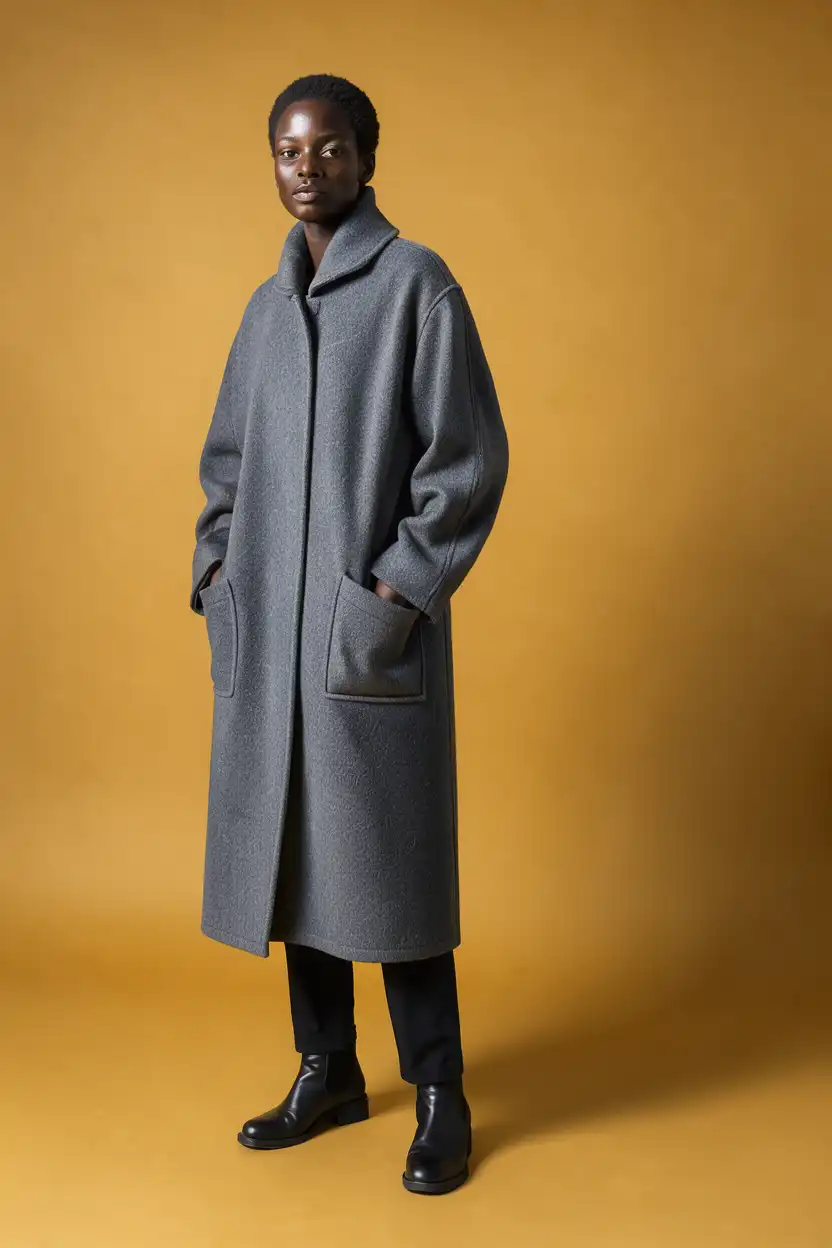
Starting from the same upsampled English as the published sample, I replaced the subject with a Japanese woman and the short natural hair with black hair tied back. The rest of the English text, 832×1248, 16 steps, and seed 1 were unchanged. The result was a full-body photo that kept the grey coat, mustard background, and hard light from the upper left.
I also wrote a caption by hand for a larger face with the same coat and background, and generated it at 832×1248 with seed 1. Under yet another condition, I specified a 21-year-old adult, a teal background, even beauty lighting, and matte skin, passed it through the official prompt upsampler, and tried seeds 1 and 42. All of these matched the initial noise layout, shift 16, and FP32 VAE to BFL’s reference implementation.
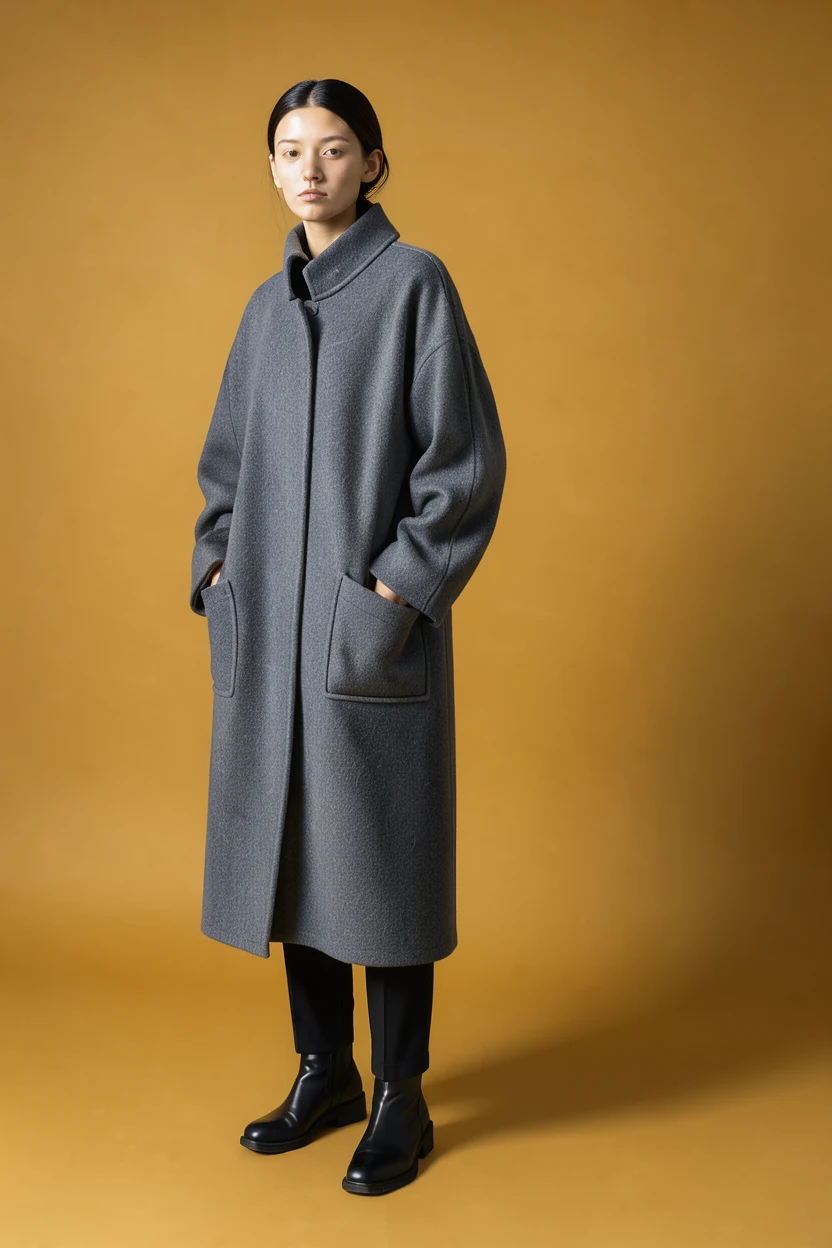
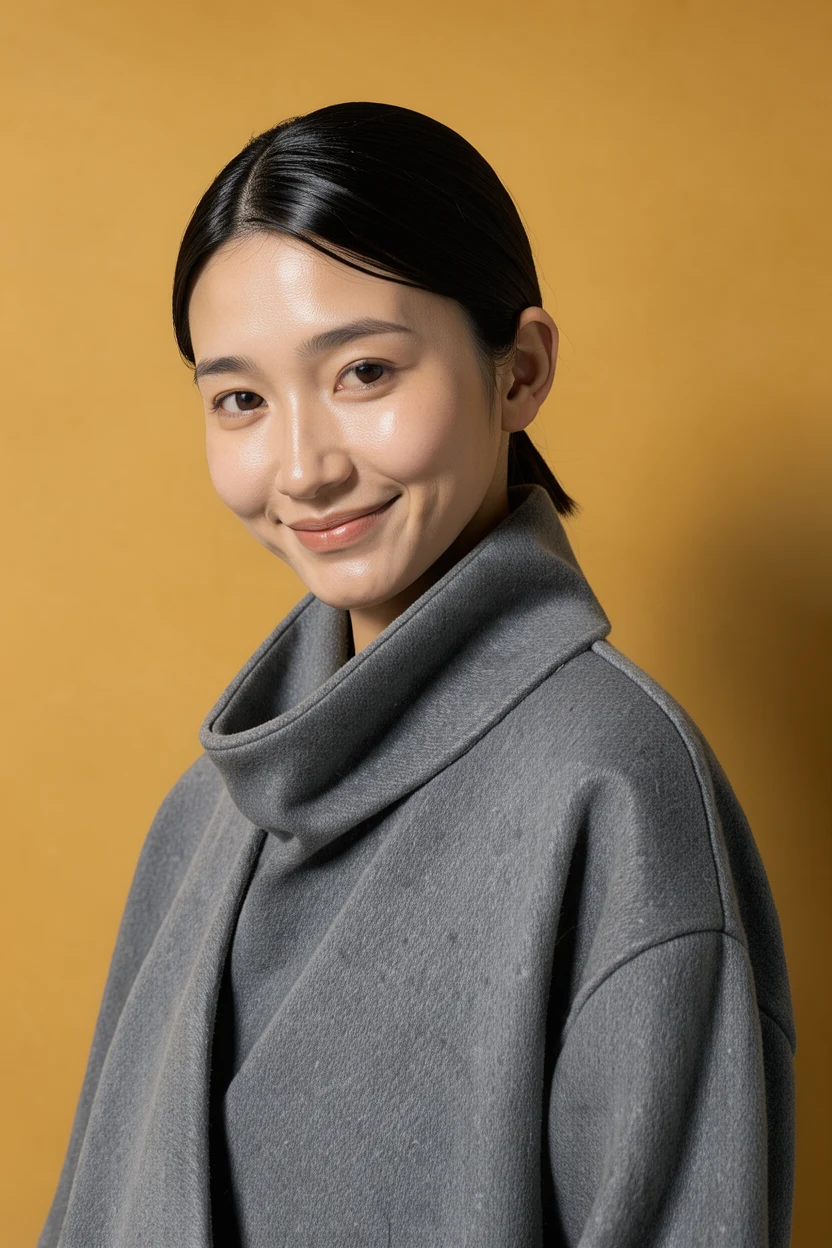
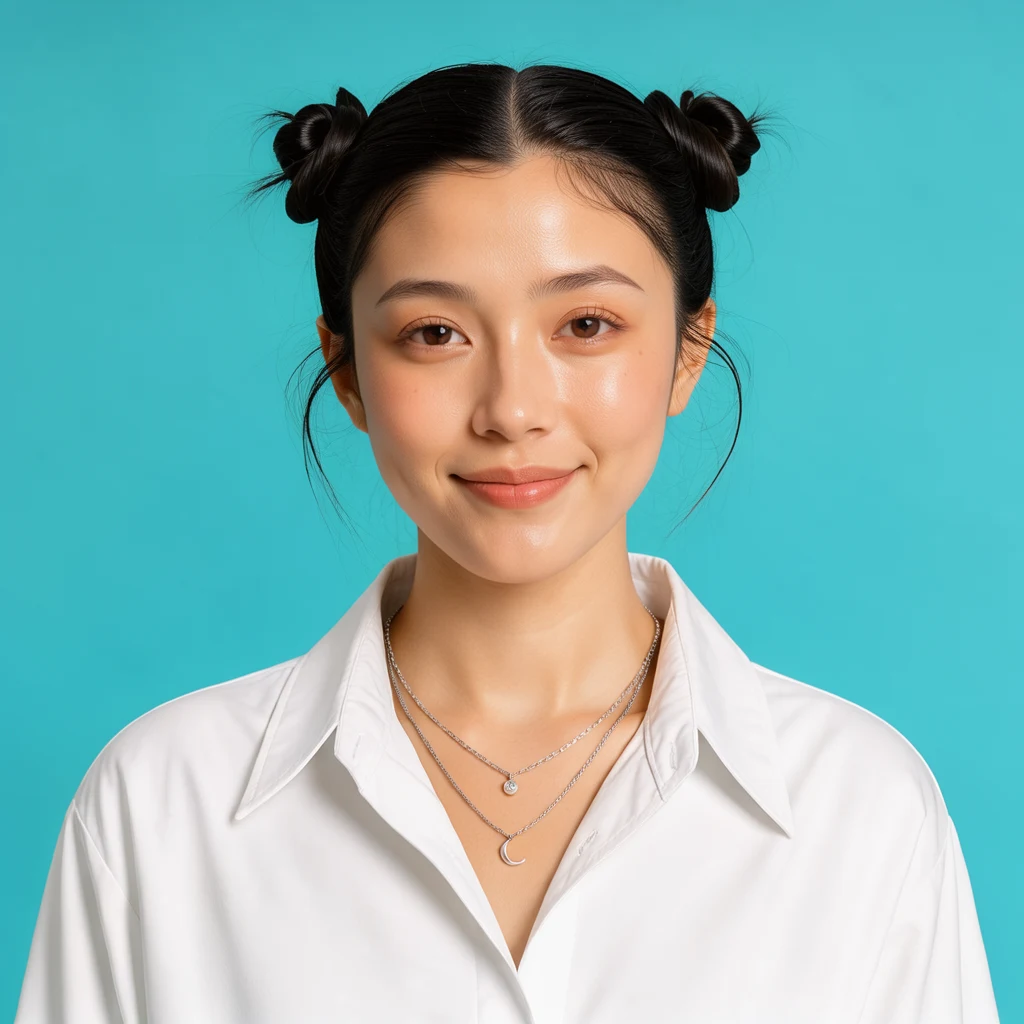
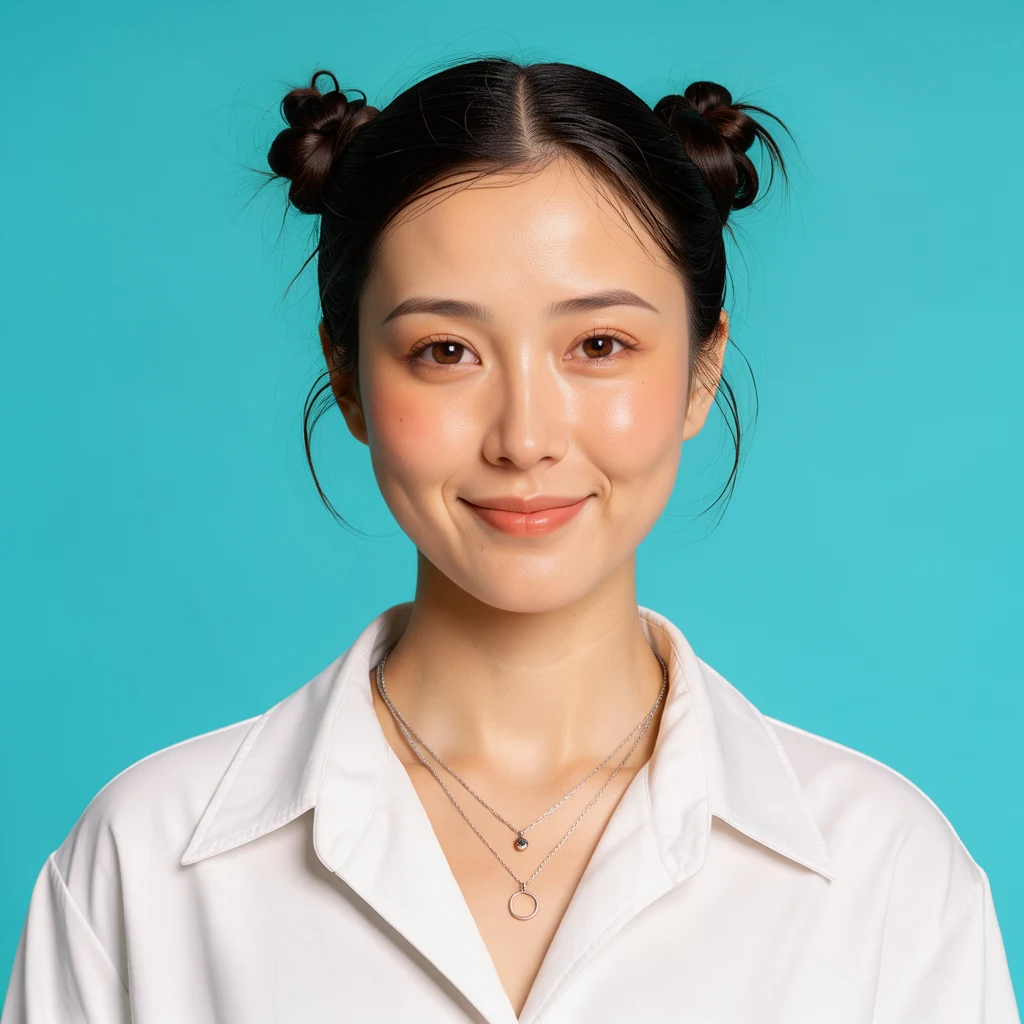
| Condition | What I saw in the image | Generation time |
|---|---|---|
| Only the subject changed from the official sample | Coat and background are close to the published sample. The face is small in the frame | 162.60 s |
| Face close-up with the same background and hard light | Face shape holds up, but reflections on the forehead and cheeks and the cheek lines of the smile stand out | 162.22 s |
| Teal background, beauty lighting, seed 1 | Background and hairstyle as specified. Shine on the cheeks and forehead remains | 161.39 s |
| Same English text, seed 42 | A different face, but shine on the cheeks and forehead remains | 176.47 s |
The full-body photo came out close to the published sample, but the face is small. The face close-up switched to different English text, so face size alone cannot be blamed. The two teal-background images changed only the seed, and both kept shine despite the matte skin instruction. Under these conditions, reproducing the official full-body sample and getting a face close-up I liked turned out to be separate things.
Prompts for the fashion and beauty photos
The full-body photo used the BFL sample JSON above, with only the description of the person replaced as follows. Background, outfit, lighting, and seed were unchanged.
- A Black female model in her twenties with dark skin and a tall, slender build → A Japanese female model in her twenties with light skin and a tall, slender build
- Her short natural hair is cropped close to the head → Her straight black hair is tied back close to the head
Full English text for the face close-up
Studio fashion portrait photograph captured on a Hasselblad medium-format camera, tight head-and-shoulders framing against an unmarked mustard seamless paper backdrop. A Japanese female model in her twenties with light skin stands just left of center, facing the camera with her shoulders turned a few degrees toward frame-left. Her straight black hair is tied back neatly, leaving her face and the high folded collar of an oversized grey wool coat clearly visible. She has a softly oval face, dark eyes, a small straight nose, smooth even skin, understated makeup, closed lips forming a restrained friendly smile, and a direct gaze. The grey coat fills the lower frame with broad wool folds and wide lapels. One hard key light from the upper left strikes her forehead, cheek, hair and the raised ridges of the wool, producing bright highlights along the left side while the right side falls into charcoal-grey shade. A crisp-edged shadow extends behind her across the mustard paper toward the lower right. The seamless backdrop has a matte surface with gentle tonal falloff. Her face is sharply focused, with the background clean and uncluttered. The composition contains only the model, coat, mustard background and shadow, with negative space above and to the right.English text fed into the official upsampler for the teal-background beauty photo
A high-end Japanese fashion magazine beauty portrait photograph of one adult woman aged 21, framed from the chest upward. She faces the camera with a calm, barely-there smile. She has a clear youthful oval face, softly almond-shaped dark eyes, a small straight nose, smooth even matte skin, and subtle peach makeup. Her black hair is styled in two small sculptural knots with a few soft wisps framing her face. She wears a crisp oversized white collared shirt and delicate layered silver necklaces. A seamless vivid turquoise studio background fills the whole image. Large frontal beauty-dish softbox lighting with broad fill creates luminous even light, soft shadows, and no wet or oily sheen. Eye-level medium-format fashion photograph with an 85mm portrait lens, sharp eyes, gentle skin rendering, polished editorial retouching, and a vivid clean color palette.The upsampled English text then sent to image generation
Studio fashion photograph, eye-level medium-format portrait with an 85mm portrait lens, framed from the chest upward against a seamless vivid turquoise background filling the entire image. Centered in the frame is one 21-year-old Japanese woman with fair skin and a clear youthful oval face, facing the camera directly. Her lips form a calm, barely-there closed-mouth smile. She has softly almond-shaped dark brown eyes, a small straight nose, smooth even matte skin, and restrained peach makeup across her cheeks and lips. Her black hair is arranged into two small sculptural knots, one above each side of her head, with a few fine wisps curving along her temples and cheeks. She wears a crisp oversized white collared shirt with broad lapels and a structured pointed collar. Two delicate layered silver necklaces rest above the collar: a fine chain with a tiny round pendant and a second chain with a slender crescent-shaped pendant. Large frontal beauty-dish softbox lighting and broad fill produce luminous, even illumination across her face, with soft shadows beneath her chin and around the knots. Her eyes are sharply focused, while the skin retains gentle tonal transitions and polished editorial retouching without oily highlights. The vivid turquoise, white, peach, black, and silver palette remains clean and saturated, with generous turquoise space surrounding her head and shoulders.Standing Portrait on White and a Running Scene
I kept the content the same as the tag lists used in the April image generation model comparison, rewrote them as natural sentences for FLUX 3, and passed them through the official prompt upsampler. A tag list is a format that lists features separated by commas, such as 1girl, solo. The FLUX 3 images were generated with shift 16, the initial noise layout, and an FP32 VAE matched to BFL’s reference implementation. The three past images are the outputs from that article, reposted as-is. In both tests the order is Anima preview3-base, WAI-Anima v1, WAI-Illustrious v160, then FLUX 3.
Standing Portrait on a White Background
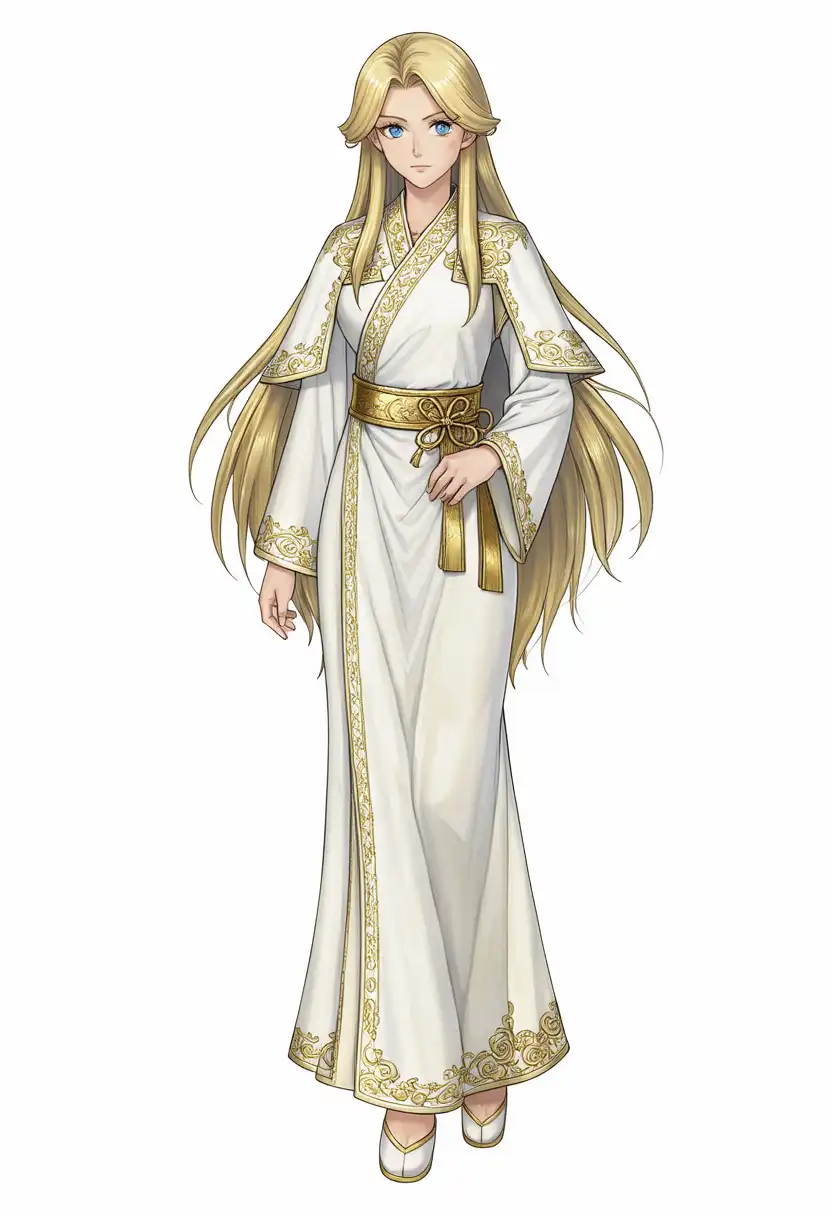
I specified a white and gold robe, blonde hair, blue eyes, and a full-body standing pose. FLUX 3 at 832×1216, 16 steps, seed 42.
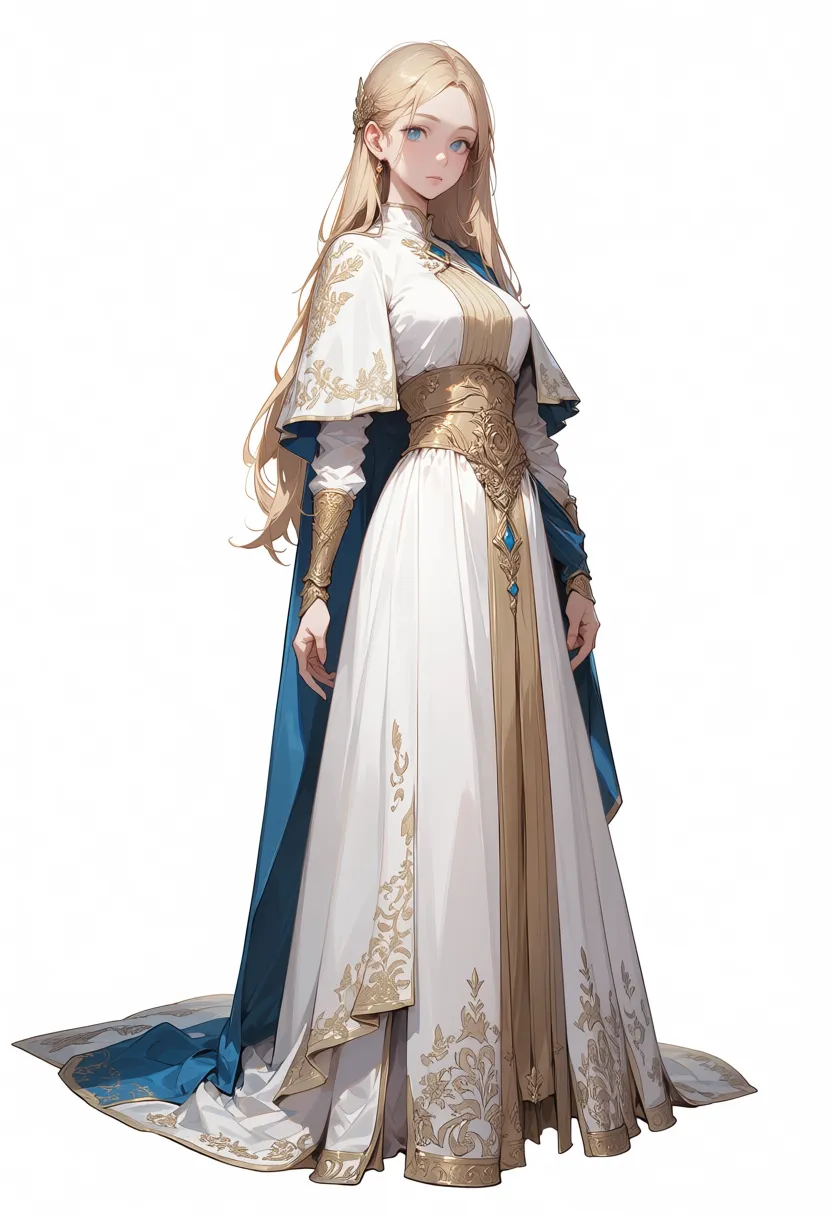
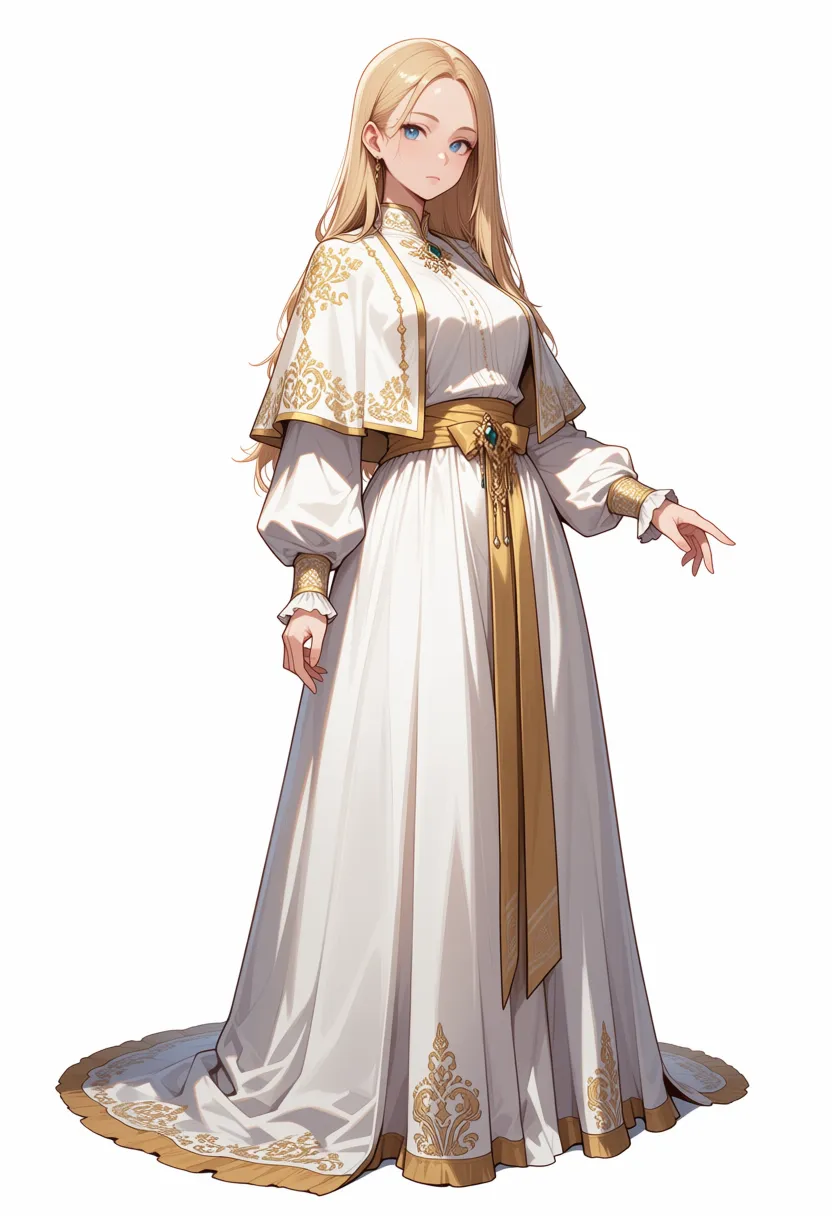
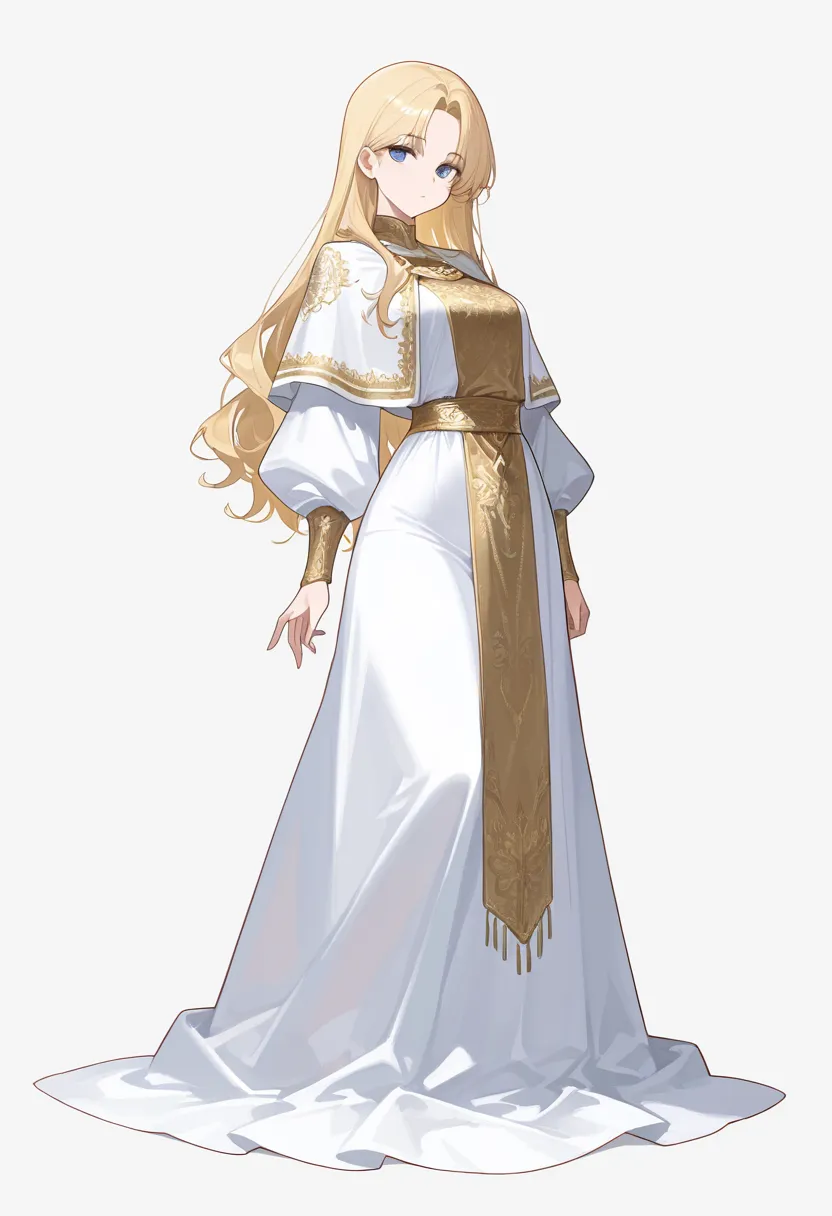
| Model | What I saw in the image |
|---|---|
| Anima preview3-base | Blue fabric is included |
| WAI-Anima v1 | Standing in a white and gold color scheme |
| WAI-Illustrious v160 | Robe and gold sash are present |
| FLUX 3 Image Klein | Head to feet fit in the frame, with a short capelet, gold embroidery, and sash |
FLUX 3 generation took 153.23 seconds. The gold embroidery and sash are finely drawn, and both feet are in frame. Even though the four images share the same seed number, the random sequences and prompt formats differ between models.
Test 1 original tag list and the English sent to FLUX 3
Original tag list:
1girl, solo, long blonde hair, blue eyes, white robe, gold embroidery, capelet, gold sash, long sleeves, long dress, standing, looking at viewer, full body, white backgroundNatural-language text passed to the official prompt upsampler:
Full-color Japanese anime illustration of one adult woman with long blonde hair and blue eyes, shown head to toe standing and looking at the viewer against a plain white background. She wears a long white robe with gold embroidery, a short capelet, a wide gold sash, and long sleeves. Show both feet and the complete robe.Upsampled English sent to FLUX 3:
Full-color Japanese anime illustration with clean cel-shaded coloring and crisp linework, showing one adult woman standing head to toe against a plain white background. She faces forward and looks directly at the viewer, centered in a full-body composition with generous white space around her. She is a woman in her twenties with fair skin, large blue eyes, and very long blonde hair falling past her waist in smooth, layered strands. Her hair spreads over her shoulders and down her back, with several loose locks framing her face. She wears a long white robe extending to her ankles, with wide sleeves and intricate gold embroidery running along the collar, cuffs, front edges, and hem. A short white capelet with gold trim rests across her shoulders, its pointed edges hanging behind her upper arms. A wide metallic-gold sash wraps around her waist, tied at the front with a structured ornamental knot and short ribbon ends. Her long sleeves hang beside her body, one hand resting near the sash and the other relaxed at her side. Below the sash, the complete white robe falls in straight folds to the floor, ending in a broad gold-embroidered border. A short capelet and the robe’s hem reveal both feet, which wear white traditional slippers with gold edging. Her posture is upright, with both feet fully shown and set a small distance apart. Even, shadowless lighting keeps the white background pure and the gold details clearly defined.Running with a Castle in the Background
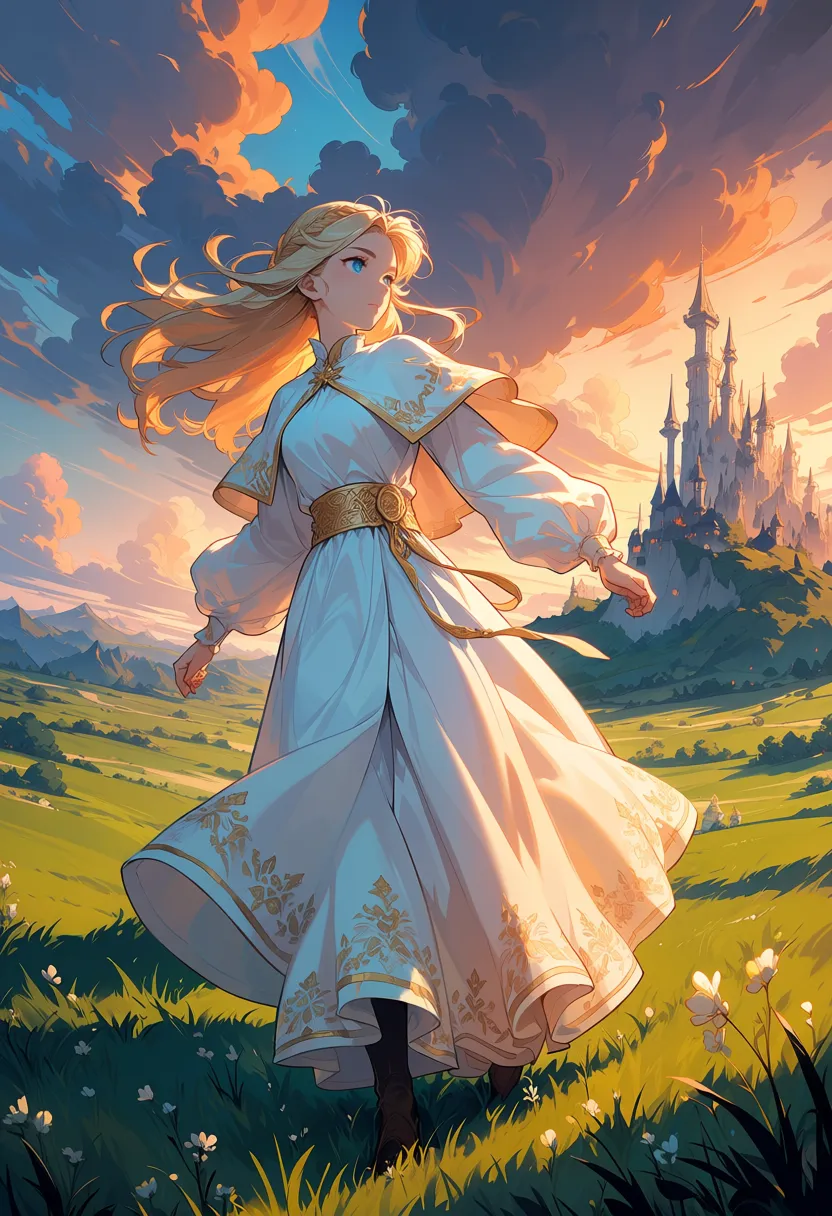
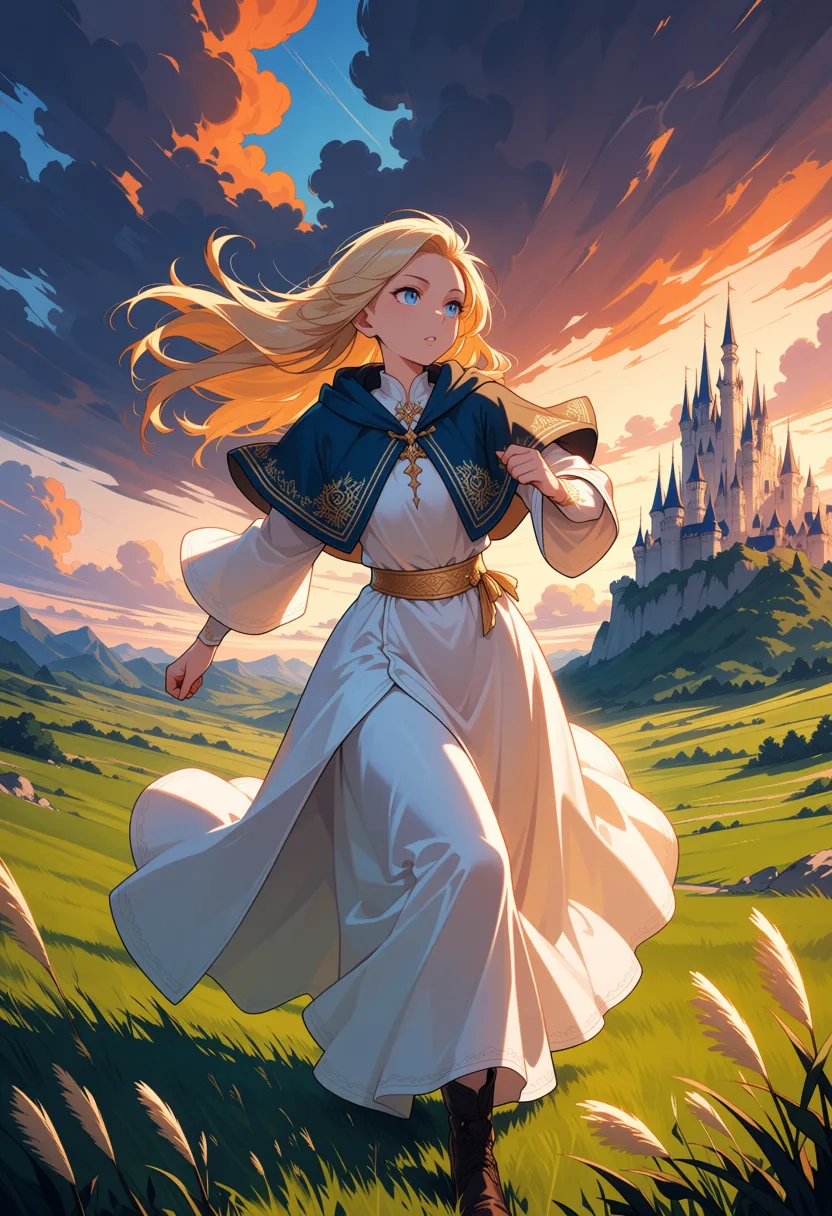
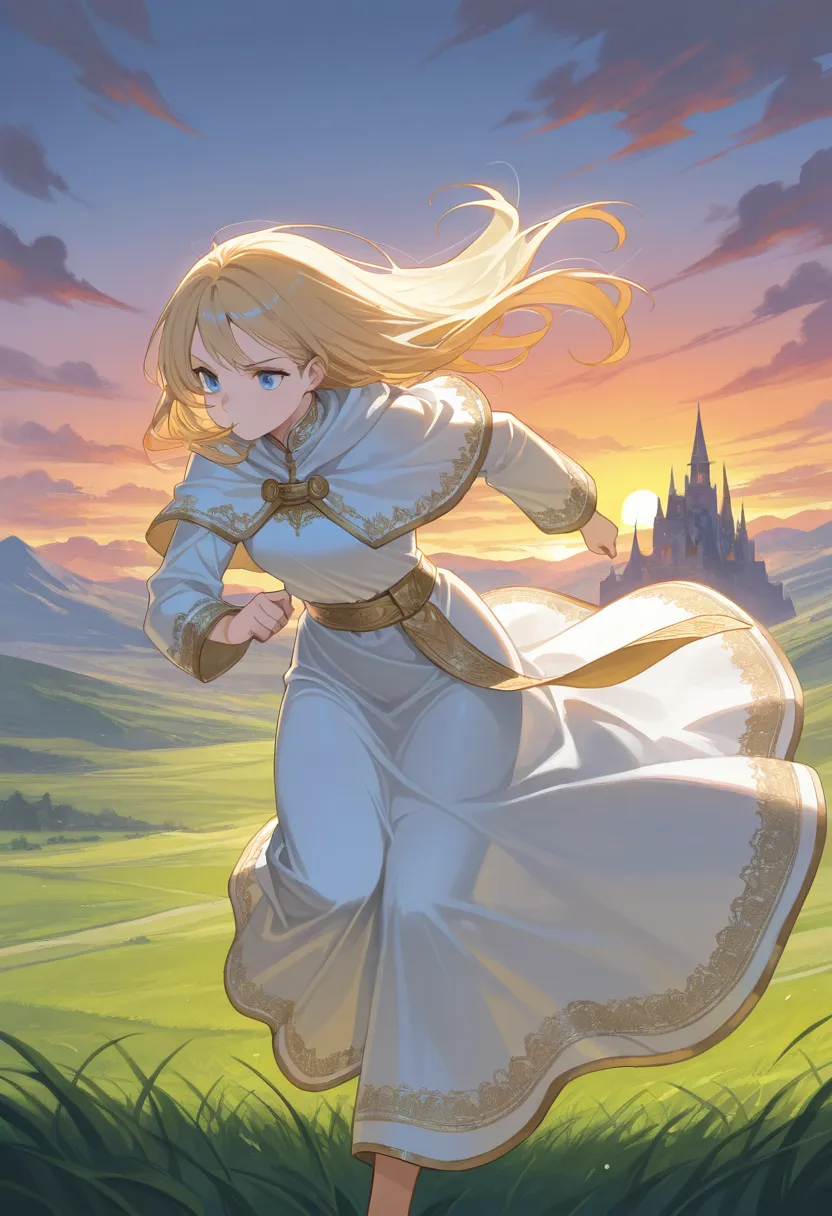
For the same character and outfit, I added a grassy field, a castle behind her, a sunset, and hair and clothes blowing in the wind. FLUX 3 at 832×1216, 16 steps, seed 42.
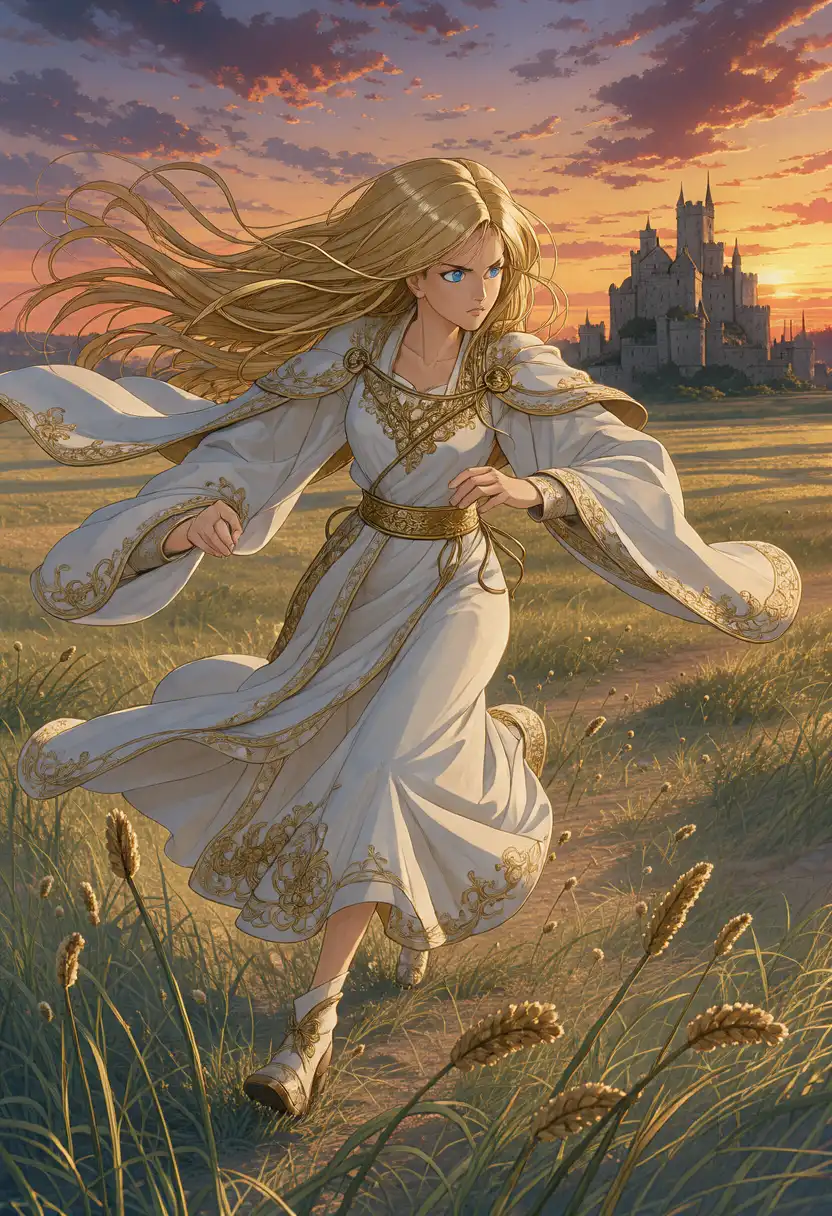
| Model | What I saw in the image |
|---|---|
| Anima preview3-base | The field, castle, and sky have depth |
| WAI-Anima v1 | A running figure, landscape, and light are included |
| WAI-Illustrious v160 | The white and gold outfit remains, but the legs are close together |
| FLUX 3 Image Klein | Castle, field, sunset sky, and wind-blown clothes are included. The forward-leaning torso and spread legs form a running pose |
FLUX 3 generation took 153.30 seconds. The specified castle, field, sunset sky, and outfit are present, and both feet are visible. However, a single still image cannot tell you whether the running motion would read as continuous.
Test 2 original tag list and the English sent to FLUX 3
Original tag list:
1girl, solo, long blonde hair, blue eyes, white robe, gold embroidery, capelet, gold sash, long sleeves, long dress, running, wind, hair blowing, dynamic pose, fantasy landscape, castle in background, sunset sky, dramatic clouds, grass fieldNatural-language text passed to the official prompt upsampler:
Full-color Japanese anime fantasy illustration of one adult woman with long blonde hair and blue eyes, wearing a long white robe with gold embroidery, a short capelet, a wide gold sash, and long sleeves. She runs through a grassy field with wind blowing her hair and robe. Full-body dynamic running pose, both feet visible. A stone castle is in the distance beneath a dramatic sunset sky with clouds.Upsampled English sent to FLUX 3:
Full-color Japanese anime fantasy illustration with crisp cel-shaded coloring, sweeping motion lines, and a wide sunset composition. In the center foreground, one adult white woman in her twenties with fair skin, large blue eyes, and very long blonde hair runs through a grassy field in a full-body dynamic pose, both feet visible. Her torso leans forward, her left leg reaches ahead while her right leg extends behind her, and the hem of her robe lifts around her stride. She wears a long white robe covered with intricate gold embroidery along the collar, cuffs, and lower hem, a short capelet fastened at the shoulders, a wide metallic gold sash around her waist, and long flowing sleeves. The capelet streams behind her as she runs, while the robe’s long sleeves whip outward in the wind. Her blonde hair sweeps high toward the left in thick windblown strands, with loose locks crossing her face and trailing behind her shoulders. Her focused eyes look toward the path ahead, and her mouth is set in a determined expression. Small seed heads and blades of grass bend around her boots, with several stalks crossing the lower foreground. In the distance, a grey stone castle with towers, battlements, and narrow spires rises above the field. The horizon glows orange and red beneath a dramatic sunset sky filled with layered violet, crimson, and amber clouds, their undersides edged in bright copper light. Long bands of shadow stretch across the field, while the woman’s white robe catches the warm rim light along its embroidered edges.Comparing with FLUX.2 and Retrying the Portrait
The earlier FLUX.2 Klein 4B article generated a landscape, a realistic portrait, and an anime character with both mflux and iris.c. Here I lined up the published mflux images against FLUX 3 images regenerated with the official upsampler and the reference settings. The subjects are the same, but for FLUX 3 the instructions were changed to natural sentences and the step count went from 4 to 16.
Autumn Garden
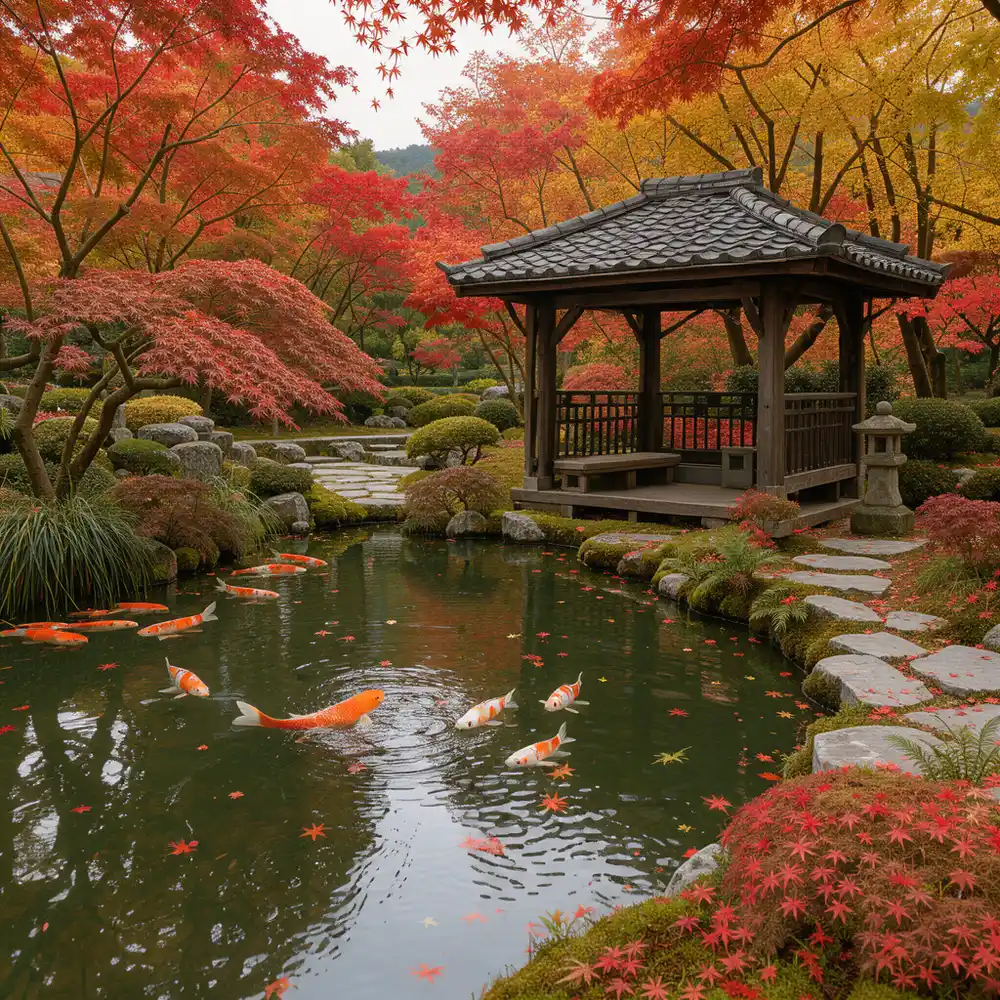
I specified a pond with koi, autumn maples, and wooden architecture. Both at 1024×1024, seed 42.
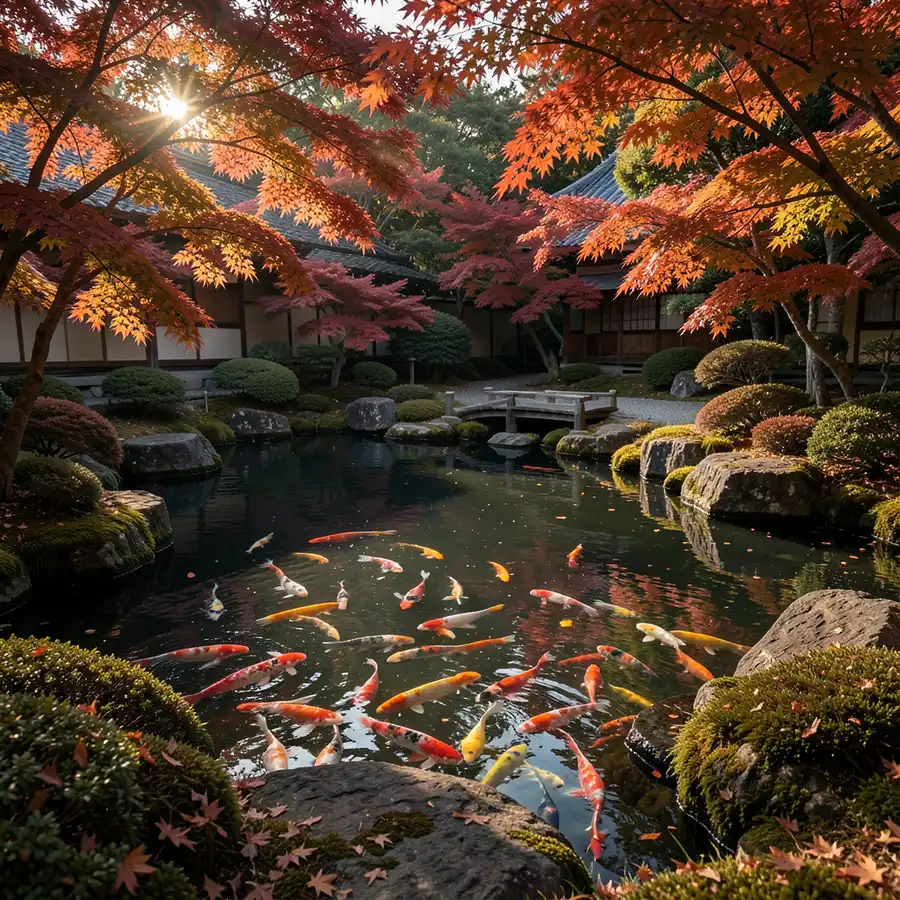
| Model | What I saw in the image |
|---|---|
| FLUX.2 Klein 4B / mflux | Wooden buildings spread out beyond the pond |
| FLUX 3 Image Klein | Koi in the pond, autumn maples, a wooden pavilion on the right, and a stone path are included |
FLUX 3 generation took 168.43 seconds. The officially upsampled English specified even the position of the pavilion, so there was more to draw than in FLUX.2’s short prompt. The difference in composition cannot be attributed to the model.
FLUX.2's short prompt and the English sent to FLUX 3
FLUX.2: a serene Japanese garden in autumn, koi pond, maple leaves
Natural-language text passed to FLUX 3’s official upsampler:
Serene Japanese garden in autumn, koi pond with orange and white fish and fallen red maple leaves, wooden pavilion and stone path beside pond, colorful maple trees, natural soft daylight, wide professional landscape photograph.Upsampled English sent to FLUX 3:
Full-color outdoor landscape photograph, wide eye-level view under soft natural daylight, showing a Japanese garden in autumn. In the foreground, a broad koi pond fills the lower half of the scene, its dark green water reflecting patches of pale sky and the red-orange maple canopy. Several orange and white koi swim beneath the surface: a large orange koi curves near the center, two white koi with orange patches glide beside it, and smaller orange-and-white fish gather near the reeds along the left bank. Fallen red maple leaves float across the water among scattered ripples, while a few leaves rest on the pond’s mossy stone edge. On the right, an irregular path of flat grey stepping stones follows the pond’s curve, bordered by low moss, small ferns, and clusters of red maple leaves. A weathered wooden pavilion stands beside the path in the midground, with dark timber posts, a broad tiled roof, and open railings facing the pond. Its shaded interior contains a simple wooden bench and a small stone lantern. On the left, a low stone path winds behind the pavilion and disappears among the trees. Colorful maple trees rise across the background in dense layers of crimson, vermilion, orange, and yellow foliage, with exposed dark branches showing through gaps in the leaves. A slender Japanese maple leans over the pond from the upper left, its branches extending above the water. Rounded rocks, clipped shrubs, and a small stone lantern sit near the pavilion, while the distant garden fades into muted green hills beneath a pale overcast sky.Realistic Portrait
The subject is a black-haired Japanese woman shot with a 50mm lens and shallow depth of field. All at 1024×1024, seed 7. The original prompt in the FLUX.2 article said young Japanese woman in her 30s. This time the official upsampler interpreted it as thirties and added visible pores, fine lines around her eyes, and light sheen across her cheeks.
Besides that condition, I generated with the reference settings a 23-year-old outdoor beauty photo and a 21-year-old magazine photo specifying an indoor composition close to the FLUX.2 image. For the last one, I replaced only the smile phrase in the upsampled English with a neutral expression and reran with the same seed.
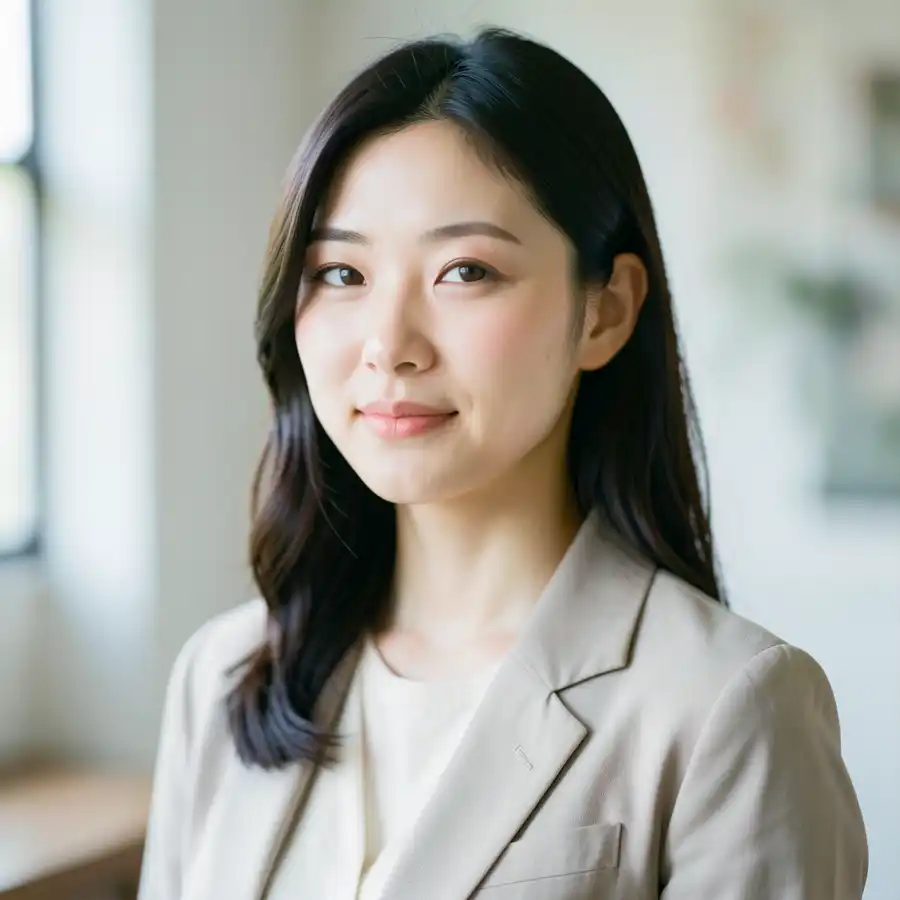
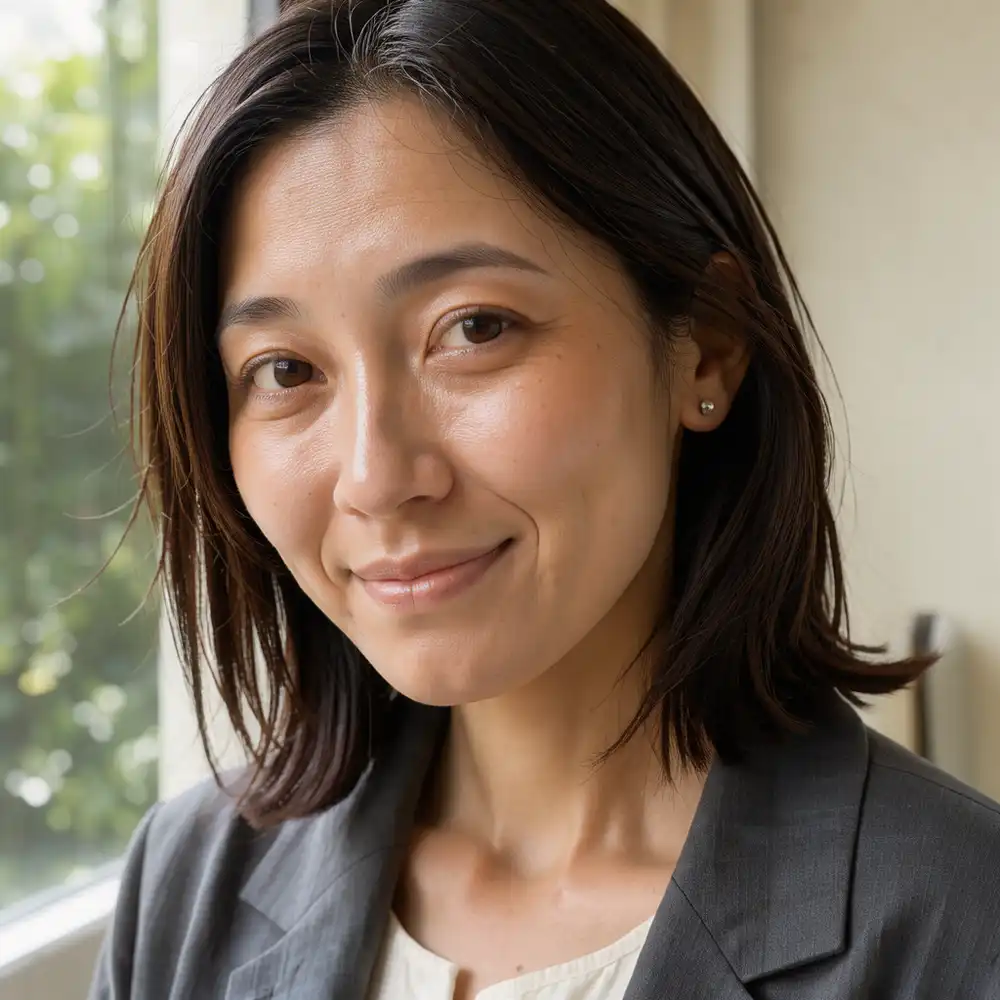
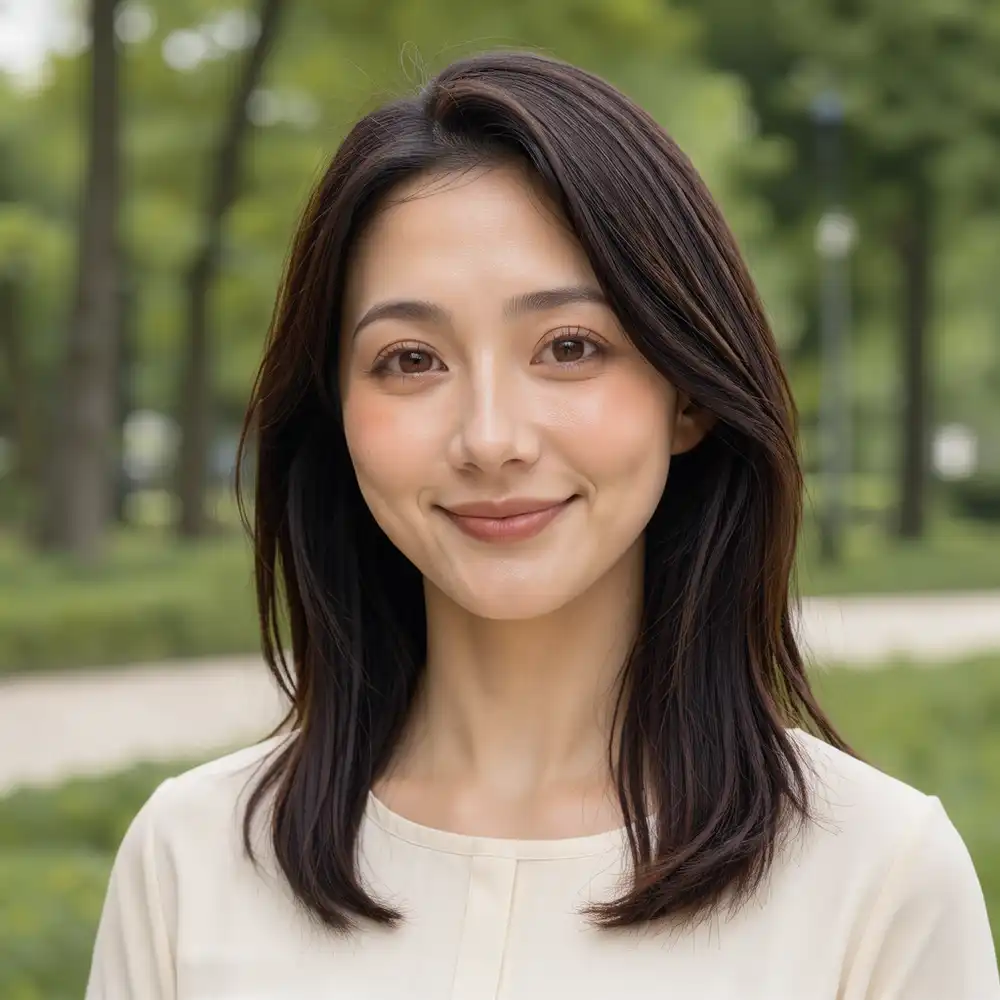

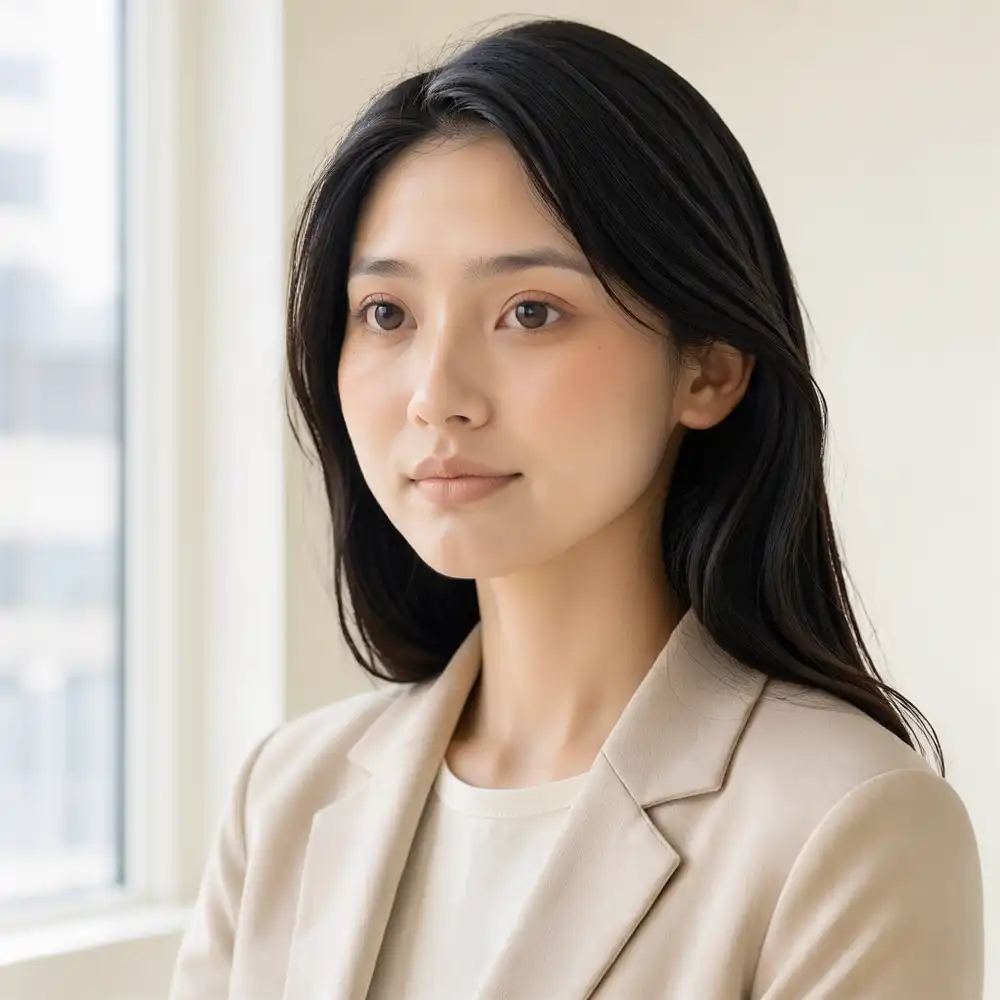
| Model / condition | What I saw in the image | Generation time |
|---|---|---|
| FLUX.2 Klein 4B / mflux | A realistic portrait centered on the face | 33.5 s |
| FLUX 3, same 30s short prompt | Shine on the cheeks, skin detail, and fine lines around the eyes stand out | 159.21 s |
| FLUX 3, 23-year-old outdoor photo | The skin became matte, but the clothes and background also differ from FLUX.2 | 161.41 s |
| FLUX 3, 21-year-old indoor photo | Window light, a beige jacket, and a soft smile are drawn. The face is a different person | 160.04 s |
| FLUX 3, only the expression changed to neutral | The smile lines on the cheeks and the raised mouth corners weakened. The eyes and facial features still differ from FLUX.2 | 160.26 s |
The FLUX 3 image from the short prompt specifying her 30s looks older than the original FLUX.2 image, and the shine is stronger. Both the original instruction and the upsampled English may have affected the facial detail. Under the 23-year-old condition the shine weakened, but even the clothes and background changed. For the 21-year-old condition, I specified in text the indoor window light, the beige jacket, and the slightly turned expression from the FLUX.2 image.
Changing the smile to a neutral expression weakened the cheek lines. Still, it did not reach the facial features or skin texture of the FLUX.2 image. Images that change age, lighting, and expression at once, compared against past FLUX.2 images, are not a controlled experiment measuring the model difference alone.
When I used the 21-year-old upsampled English and seed 7 with BFL’s reference implementation too, it gave almost the same face as the Diffusers version. The mean absolute pixel difference between the original PNGs was 0.53 / 255. The facial look seen under this condition is not something that arose only in Diffusers.
21-year-old indoor photo from BFL's reference implementation

FLUX.2's short prompt and the English sent to FLUX 3
FLUX.2’s short prompt (the same text was also fed into FLUX 3’s official upsampler):
portrait of a young Japanese woman in her 30s, professional photography, natural light, soft skin texture, 50mm lens, shallow depth of fieldUpsampled English sent to FLUX 3:
Close-up outdoor portrait photograph of a young Japanese woman in her thirties, photographed at eye level with a 50mm lens and shallow depth of field. She faces the camera in a head-and-shoulders composition, her face placed just left of center and turned a few degrees toward the light. She has fair skin with visible pores, fine lines around her eyes, and a light sheen across her cheeks, straight dark brown hair cut to shoulder length, and wispy strands resting near her temples. Her dark brown eyes look directly into the lens, with relaxed brows and a closed mouth forming a restrained half-smile. She wears a charcoal-gray linen blazer over a plain ivory blouse, with a small silver stud earring in her left ear. Natural daylight enters from the left through a nearby window or open shade, illuminating her face with broad highlights and leaving a mild shadow along the right side of her nose and jaw. The background falls out of focus into muted green foliage and a pale cream wall, with no distinct objects. A few loose strands of hair cross the blurred background, while the focus remains on her eyes, eyelashes, and the fine texture of her skin.Natural-language text passed to the official upsampler for the additional beauty photo condition:
Polished Japanese beauty-editorial portrait photograph of an adult woman age 22 to 25. Conventionally attractive youthful face, gentle friendly smile, straight dark hair, subtle flattering natural makeup, smooth even matte skin with restrained highlights. Cream blouse, green park blurred behind her, chest-up composition, eye-level 50mm lens. Large softbox-like overcast daylight, soft low-contrast shadows and natural color. The skin should look smooth and lifelike without a wet or shiny finish.Its upsampled English:
Full-color outdoor portrait photograph, chest-up composition at eye level with a 50mm lens, showing a Japanese woman aged 23 centered against a blurred green park. She has fair skin, a conventionally attractive youthful face, straight dark brown hair falling neatly past her shoulders, and a few fine strands resting near her temples. Her lips form a gentle closed-mouth smile, with the corners of her mouth raised and her dark brown eyes directed toward the camera. Her makeup is restrained and natural: an even complexion, softly defined brows, muted brown eyeliner, light mascara, a small wash of peach blush, and a muted rose lip color. Her skin has a smooth, even matte finish with restrained highlights across the forehead, cheeks, and nose, retaining fine facial texture without a wet or shiny surface. She wears a simple cream blouse with a modest round neckline and a narrow fold at the collar. Broad, diffused overcast daylight from a large softbox-like source illuminates her face evenly, producing low-contrast shadows beneath her chin and nose. Behind her, the park dissolves into broad out-of-focus masses of green foliage, pale tree trunks, and a muted cream path, with no distinct background details. The natural color palette remains balanced, with warm cream, neutral skin tones, and subdued greens.Prompts for the 21-year-old indoor photo
Input to the official upsampler
A clean Japanese magazine beauty portrait photograph of one adult woman aged 21. She has a youthful softly oval face, smooth cheeks, a gently tapered jaw, large softly almond-shaped dark eyes, a small straight nose, and a warm subtle smile. Long glossy black hair with a natural side part falls over her shoulders. She wears a light beige tailored blazer over a plain ivory crew-neck top and delicate natural makeup. Three-quarter upper-body portrait, shoulders angled a little to camera-right, eyes looking just to camera-left. A bright cream indoor setting with a softly blurred window on the left. Gentle broad daylight, high-key exposure, soft shadows, natural color, smooth even matte skin, and a flattering 50mm shallow-depth-of-field photograph. The result should look like a polished but natural portrait for a Japanese fashion magazine.Upsampled English sent to image generation
Full-color indoor beauty photograph for a Japanese fashion magazine, a three-quarter upper-body portrait shot with a 50mm lens and shallow depth of field. One 21-year-old Japanese woman with fair skin fills the center and right side of the frame from the upper chest upward. She has a youthful, softly oval face, smooth cheeks, a gently tapered jaw, large dark eyes with softly almond-shaped lids, a small straight nose, and a warm closed-mouth smile with the corners of her lips raised. Her long, glossy black hair is parted naturally to one side and falls in smooth sections over both shoulders, with a few fine strands resting near her temple. She wears a light beige tailored blazer over a plain ivory crew-neck top, the lapel forming a clean diagonal across her shoulder. Her makeup is delicate and natural, with an even matte complexion, softly defined brows, muted peach blush, fine brown eyeliner, and a sheer rose-beige lip color. Her shoulders angle toward camera-right while her head turns back toward the viewer and her eyes look just to camera-left. Broad daylight from the left creates a high-key exposure, even illumination across her face, and pale shadows beneath her jaw and nose. Behind her is a bright cream interior. On the left, a large window dissolves into a soft white and pale blue blur, with no distinct exterior details. The remaining background is an uncluttered cream wall, leaving generous open space around her head for a restrained magazine portrait layout.For the neutral expression, only a warm closed-mouth smile with the corners of her lips raised in the English above was replaced with a calm neutral expression with her lips gently closed and her cheeks relaxed. All other wording plus 1024×1024, 16 steps, seed 7, shift 16, the noise layout, and VAE FP32 were the same.
Retrying the Portrait with aiaicreate’s Rainy Café Prompt
aiaicreate’s ComfyUI experiment article includes an English prompt and image of a woman sitting by the window of a rainy café.
That article recommends 50 steps when you want quality from the Base version, and for the distilled version it also compares results with and without the prompt upsampler. The distilled, no-upsampler image shows the face in soft light from the window. The seed for the photo is not given in the article text. The 16 steps for the distilled version used here follow BFL’s model card.
First, I passed that English prompt as-is to the distilled version on this Mac.
Next, I kept the rainy café scene, stated the person as a 21-year-old Japanese woman, and described the expression, window light, and skin texture. I generated this without the upsampler and with the official upsampler, both from seed 1. The upsampled English was also tried with seed 42. All conditions were 1024×1024, 16 steps, the same noise layout as BFL’s reference implementation, shift 16, and an FP32 VAE. The Base version was not run on this Mac.
| Condition | What I saw in the image | Generation time |
|---|---|---|
| Prior article’s English as-is, no upsampler, seed 1 | The rainy window and white cup appeared. Skin shine is weaker than the earlier beauty photos, but the expression is stiff | 154.13 s |
| 21-year-old Japanese woman, window light and matte skin specified, no upsampler, seed 1 | No strong reflection on the forehead. The cheek lines of the smile remain | 154.29 s |
| Same input officially upsampled, seed 1 | No strong reflection, but the cheek lines of the smile remain | 159.62 s |
| Same upsampled English, seed 42 | The face shape changed, but the cheek lines and skin detail remain | 159.50 s |
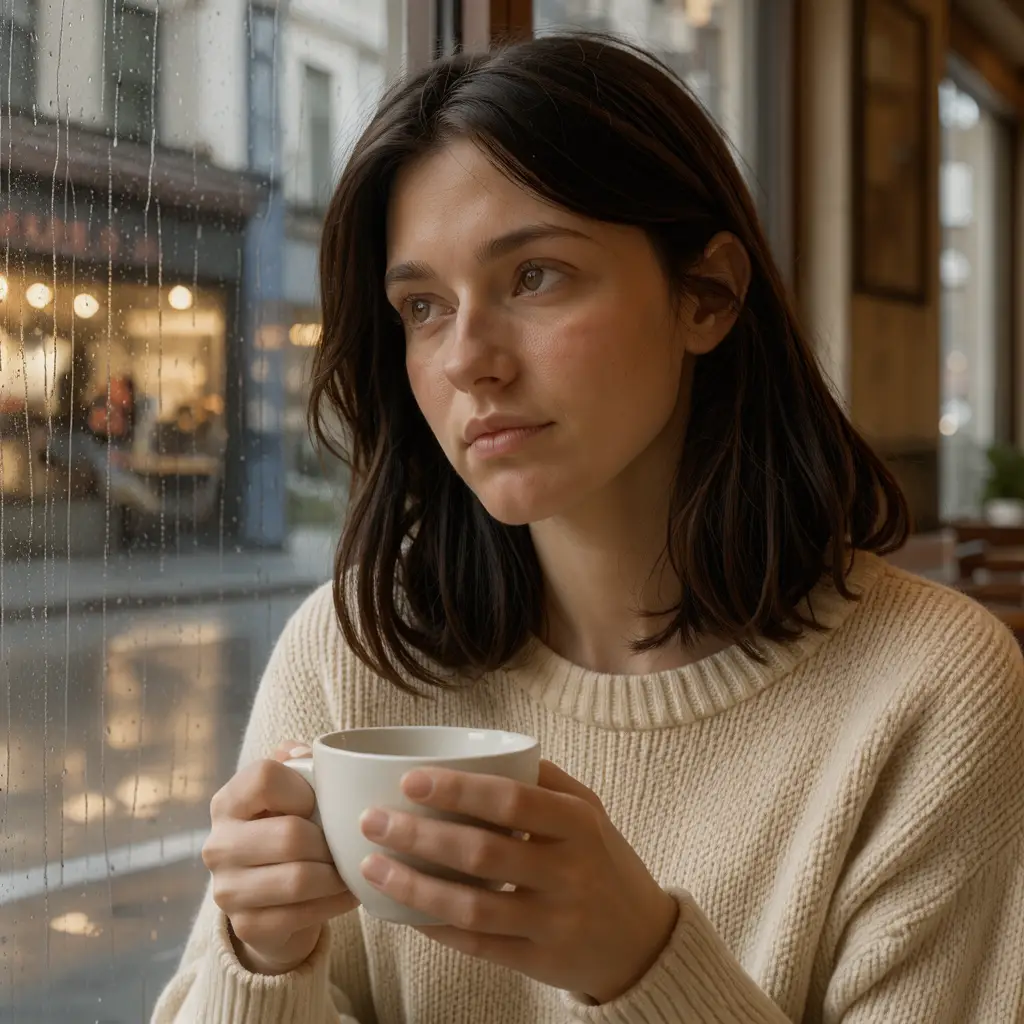
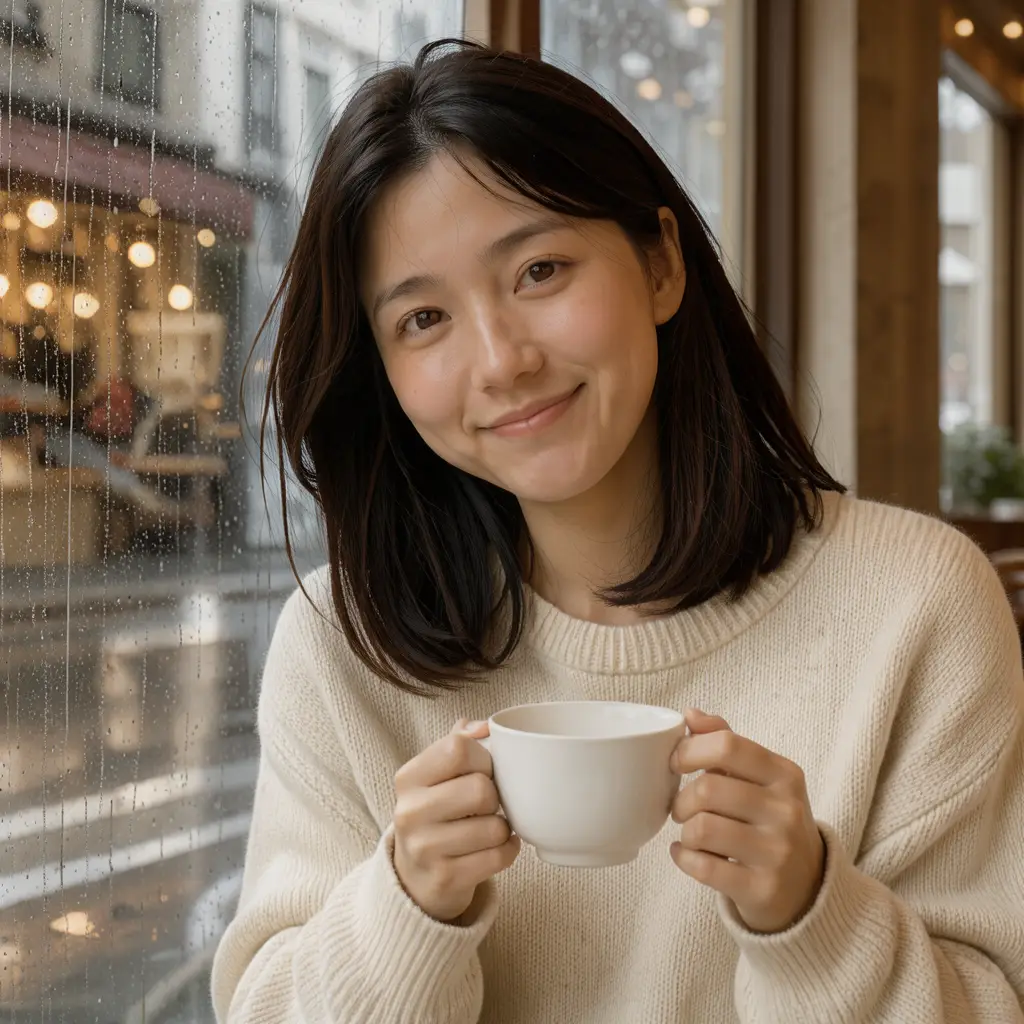
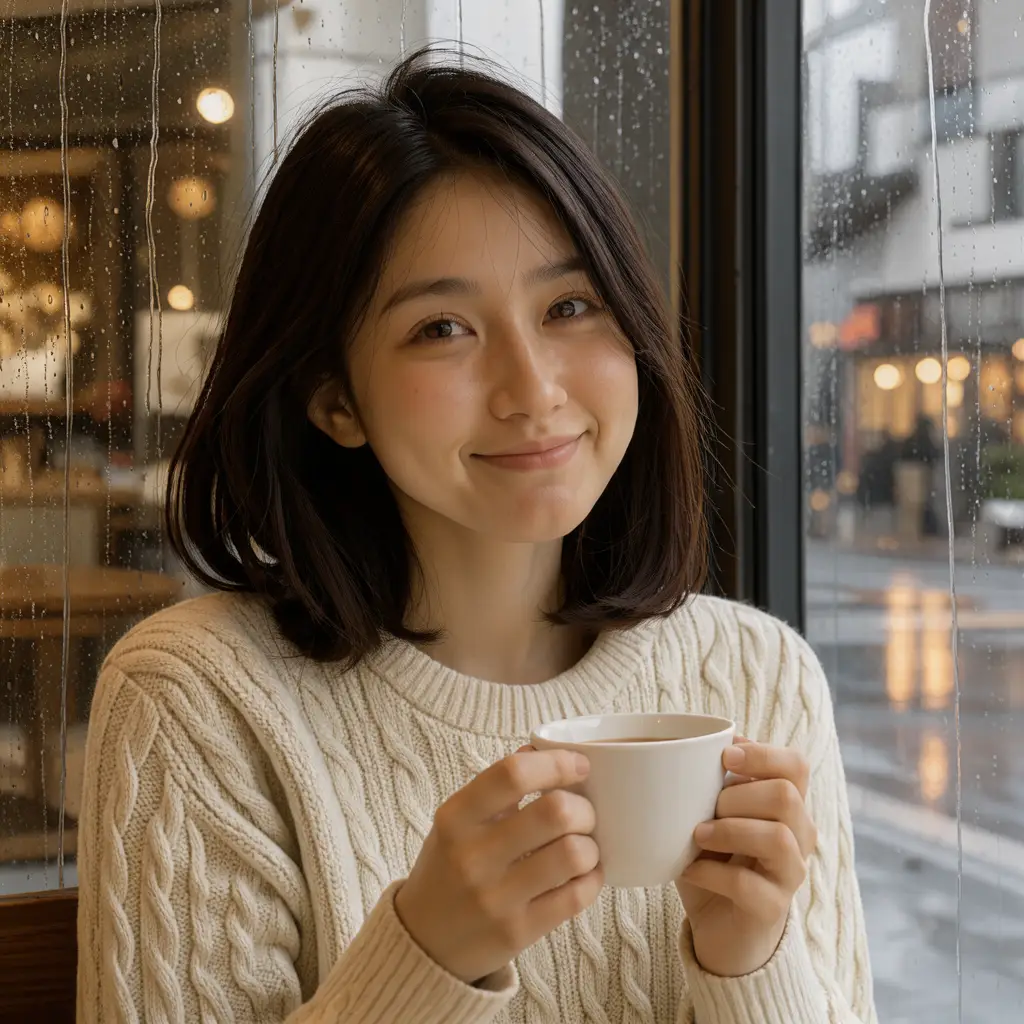
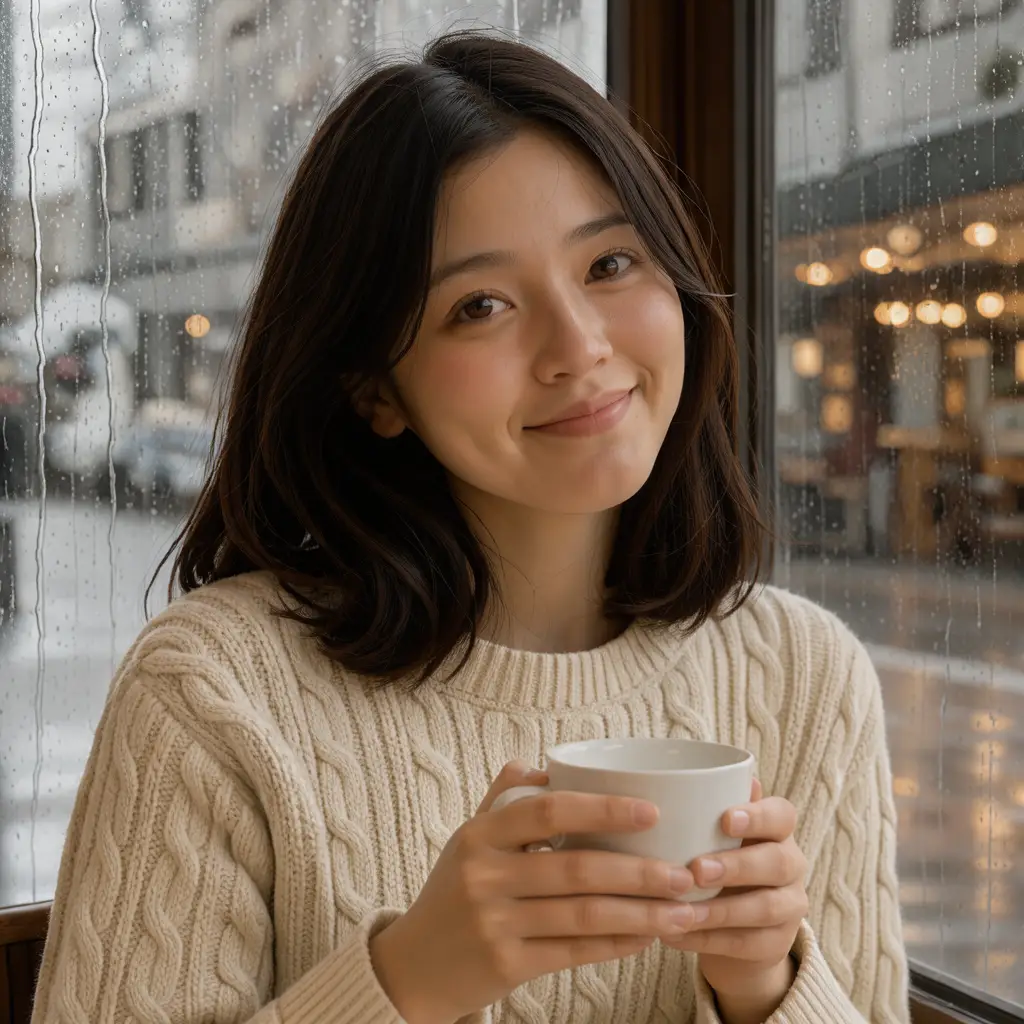
In the three conditions specifying age 21, reflections on the cheeks and forehead are weaker than in the hard-light face close-up or the teal-background beauty lighting. But the cheek lines of the smile and the odd look of the facial features remained. On the teal background, shine appeared even though the matte skin instruction was still in the upsampled English, so the word “matte” alone cannot explain the result. The effect of window light also cannot be isolated, because I changed the person, lighting, and skin instructions together.
The upsampled English adds facial detail and lighting instructions. If you check it before generating, you can catch things like fine lines and light sheen from the 30s example here. Still, writing “matte” in the English did not necessarily remove shine from the image.
English used for the rainy café portraits
The English passed as-is from the prior article is published in the “photoreal” section of the source article. The English for the other two conditions is below.
English entered directly for the 21-year-old condition and also passed to the upsampler:
Natural-light portrait photograph of a Japanese woman aged 21 sitting beside a large rain-speckled café window. She has shoulder-length dark brown hair, a softly rounded youthful face, dark brown eyes, and a small relaxed smile as she looks slightly toward the camera. She wears a cream knit sweater and holds a plain white ceramic cup with both hands. Her head and upper torso fill the frame, with her face in sharp focus. Soft overcast daylight through the window lights her face evenly; shadows are gentle and the skin has a natural matte finish. Outside the window, warm shop lights blur against the wet street. Eye-level portrait, muted cream and warm brown colors.English passed from the official upsampler to image generation:
Full-color indoor portrait photograph in natural overcast daylight, shot at eye level with a close head-and-shoulders composition. A 21-year-old Japanese woman with fair skin sits beside a large café window, her head and upper torso filling most of the frame. She has a softly rounded youthful face, shoulder-length dark brown hair with a few loose strands resting near her cheeks, dark brown eyes, and a small closed-mouth smile with relaxed corners. She looks just toward the camera. She wears a cream cable-knit sweater with a ribbed neckline and holds a plain white ceramic cup securely in both hands at the lower center of her chest, one hand wrapped around each side. The window glass rises behind her head and shoulders, covered with scattered raindrops and several narrow rivulets running downward. Soft grey daylight passing through the wet glass illuminates her face evenly, leaving gentle shadows beneath her chin and nose and a natural matte finish across her skin. On the right, the window continues into a blurred view of the wet street outside. Warm amber shop lights dissolve into round golden highlights among indistinct dark storefront shapes and muted reflections on the pavement. The palette remains muted cream, warm brown, and subdued grey, with the woman’s face held in sharp focus and the exterior reduced to soft light and color.Anime Character in a Cherry Blossom Park
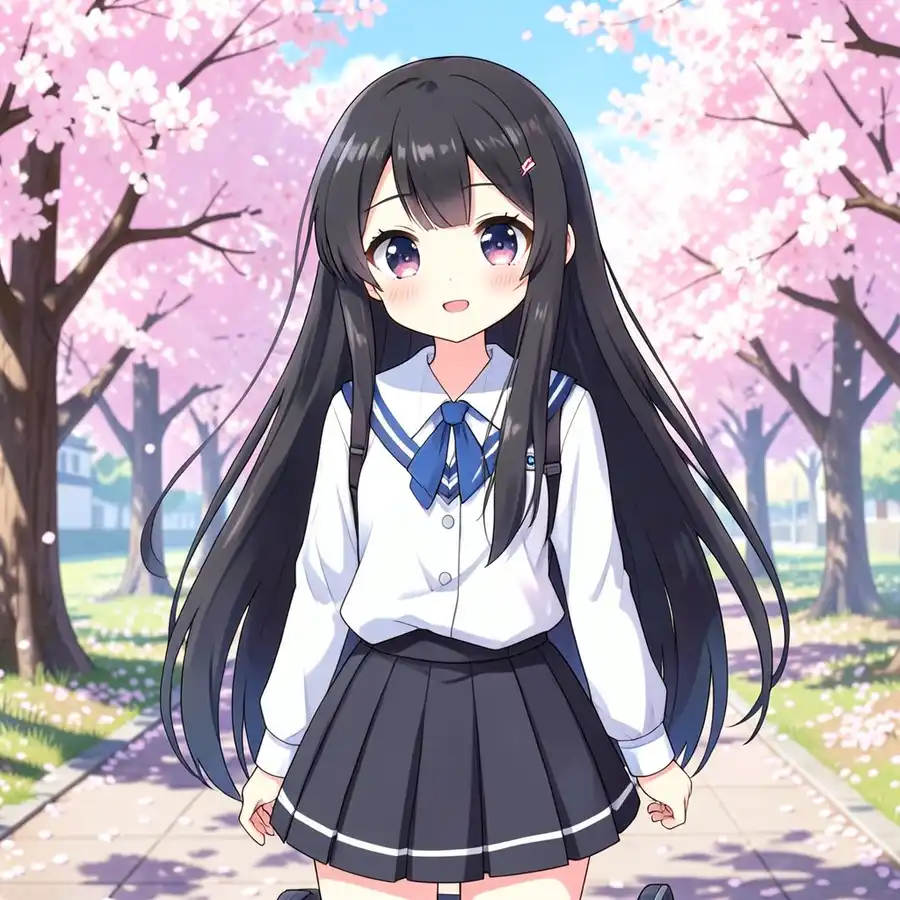
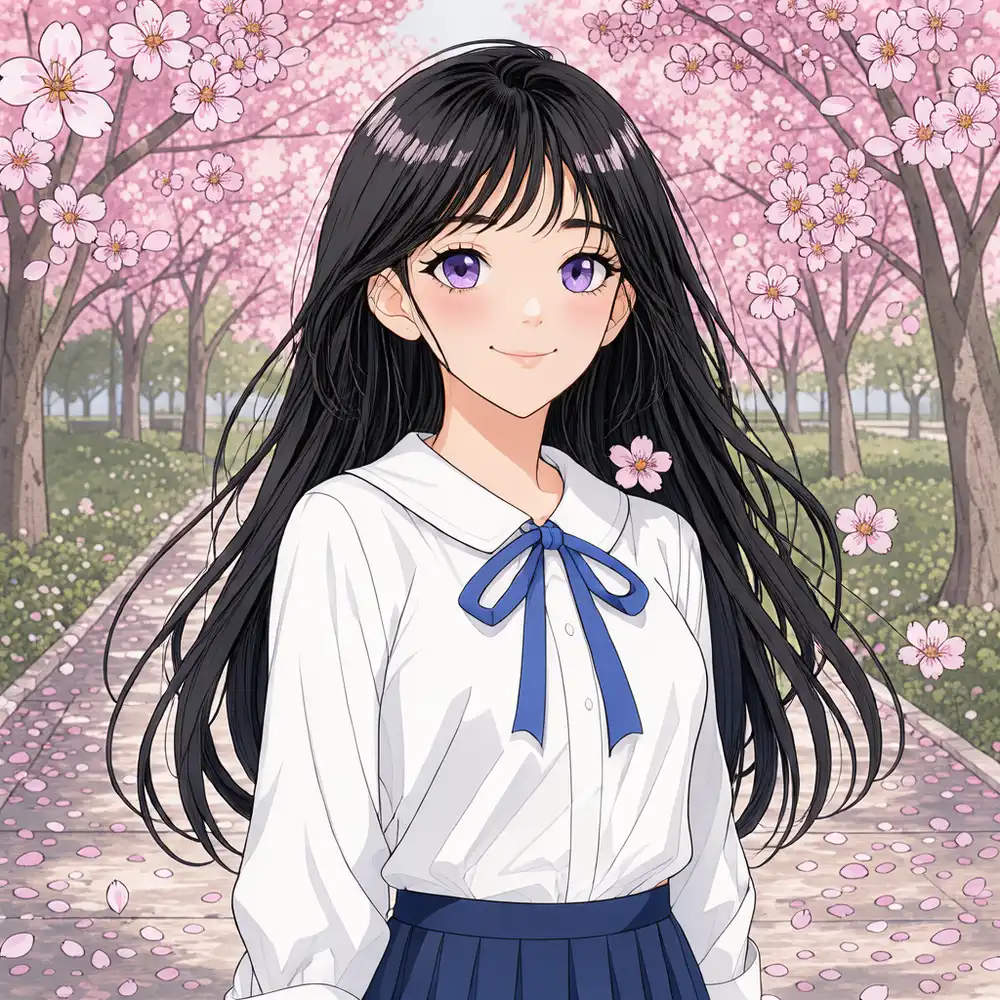
The subject is black hair, a school uniform, and a cherry blossom park. Both at 1024×1024, seed 7.
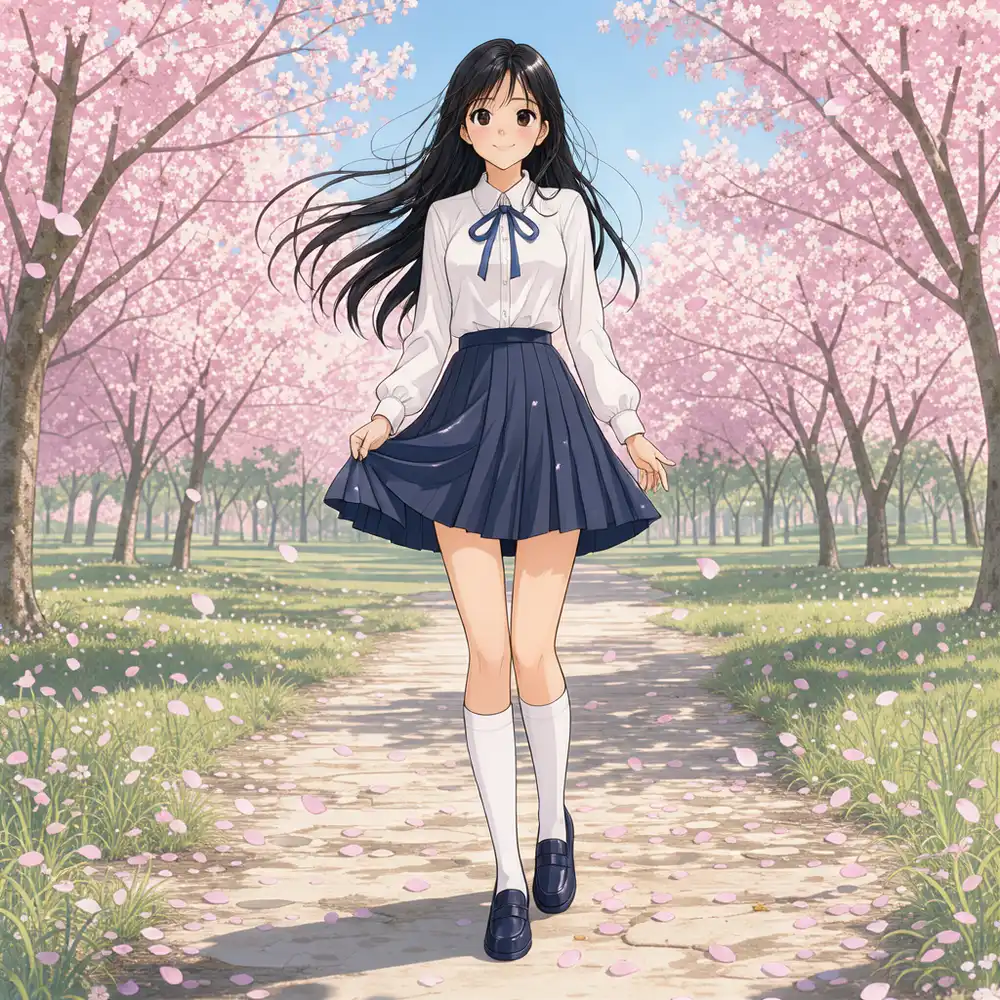
| Model / condition | What I saw in the image | Generation time |
|---|---|---|
| FLUX.2 Klein 4B / mflux | Mainly the upper body, with cherry blossoms in the background | 31.0 s |
| FLUX 3, larger face | An upper-body-leaning figure, a row of cherry trees, and a park path | 160.33 s |
| FLUX 3, about 7 heads tall | A full-body figure from head to shoes and a row of cherry trees | 172.25 s |
For the larger-face condition, I specified violet eyes, a white blouse with a blue ribbon, and thin lines with cel shading to the official upsampler. The face ended up about the same size in the frame as in the FLUX.2 output. For the other image, I entered a separate full-body, seven-head-tall description into the official upsampler; the result included the shoes.
FLUX.2's short prompt and the English sent to FLUX 3
FLUX.2: anime girl with long black hair, school uniform, standing in cherry blossom park, anime illustration style, big eyes, kawaii
Natural-language text passed to FLUX 3’s official upsampler:
A polished contemporary 2D Japanese moe anime illustration of a beautiful adult woman age 20 with long black hair, large expressive violet eyes with soft highlights, a small delicate nose and mouth, gentle smile and faint rosy blush. She wears a white blouse with a blue ribbon and navy pleated school-style skirt. She stands on a path in a cherry blossom park. Medium portrait from the top of her head to mid-thigh, face large and clear in the frame, pink blossoms around her. Thin clean ink outlines, flat smooth skin color, restrained pastel cel shading, no chibi proportions and no photorealistic skin texture.Upsampled English sent to FLUX 3:
Polished contemporary 2D Japanese moe anime illustration with thin, clean ink outlines, flat smooth skin coloring, and restrained pastel cel shading. A medium portrait framed from the top of her head to mid-thigh centers on a beautiful 20-year-old East Asian woman standing on a pale stone path in a cherry blossom park. Her face fills most of the composition, with long black hair falling past her shoulders in smooth tapered strands and a few loose locks curving beside her cheeks. She has large expressive violet eyes with crisp dark lashes, bright lavender irises, and soft white highlights, a small delicate nose and mouth, a gentle closed-mouth smile, and a faint rosy blush across both cheeks. She wears a neat white blouse with a rounded collar and a blue ribbon tied at the neckline, paired with a navy pleated school-style skirt whose upper pleats remain visible in the lower portion of the portrait. Her posture is upright, with one shoulder turned a little toward the viewer. Pink cherry blossoms and clusters of pale pink petals surround her head and shoulders, with several blossoms overlapping the outer edges of her hair. Behind her, flowering cherry branches arch across the upper background, while the path recedes between simplified pink tree trunks and muted green foliage. The palette combines white, navy, violet, blush pink, and pale blue, with crisp cel-shaded shadows beneath her hair, ribbon, chin, and skirt folds.English fed into the official upsampler to produce the full-body figure about 7 heads tall
A polished 2D Japanese anime key visual of one beautiful young adult woman in her early twenties standing full-body on a path through a cherry blossom park. Her build and face have standard anime human proportions, approximately seven heads tall, with an elegant small face and large but proportionate expressive dark eyes. Long black hair, a white blouse, navy pleated skirt, blue ribbon at the collar, knee socks and loafers. She gives a soft friendly smile with a subtle pink blush. Flowing hair and pink petals, spring daylight. Fine clean hand-drawn outlines, smooth flat-color skin and soft pastel cel shading, as in a contemporary anime illustration. Show both shoes and the top of her head, with no tiny chibi proportions.Background Change Using a Kana-chan Image
From here on, image editing, layout control, and the NSFW output tests used the initial Diffusers settings: shift 6.93, the default noise layout, a BF16 VAE, and no official upsampler. They were not rerun with the settings matched to the BFL sample, so I only record the extent to which they worked.
I passed the source image used in the April image generation model comparison, made with WAI-Illustrious v160 plus the Kana-chan LoRA, to FLUX 3.
The instruction was to change the background to a row of cherry trees while keeping the brown side ponytail with a blue tie, the white robe, and the gold embroidery and sash. For editing, I used the source image as a reference and described its hairstyle, clothing, and the finished scene in English. I did not specify denoise 0.5, a setting for how strongly to redraw the source image. 832×1216, 16 steps, seed 42.
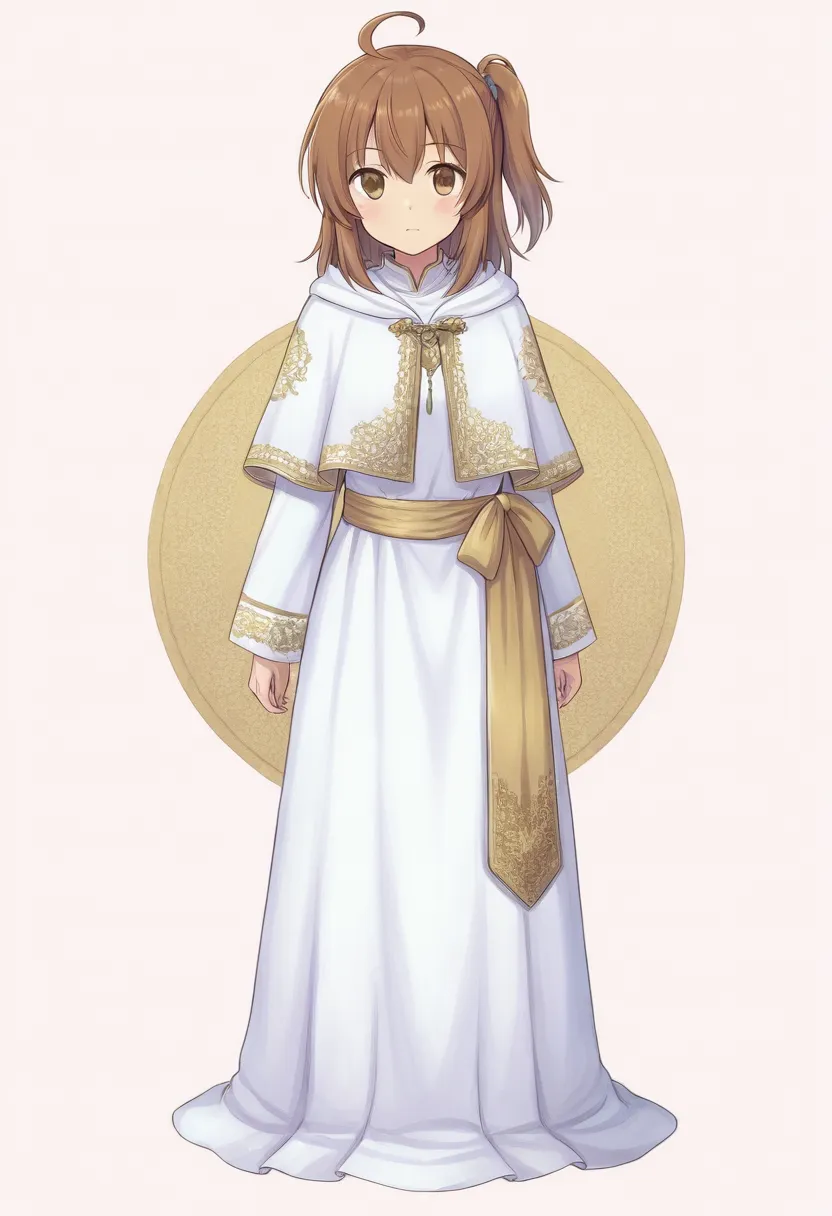
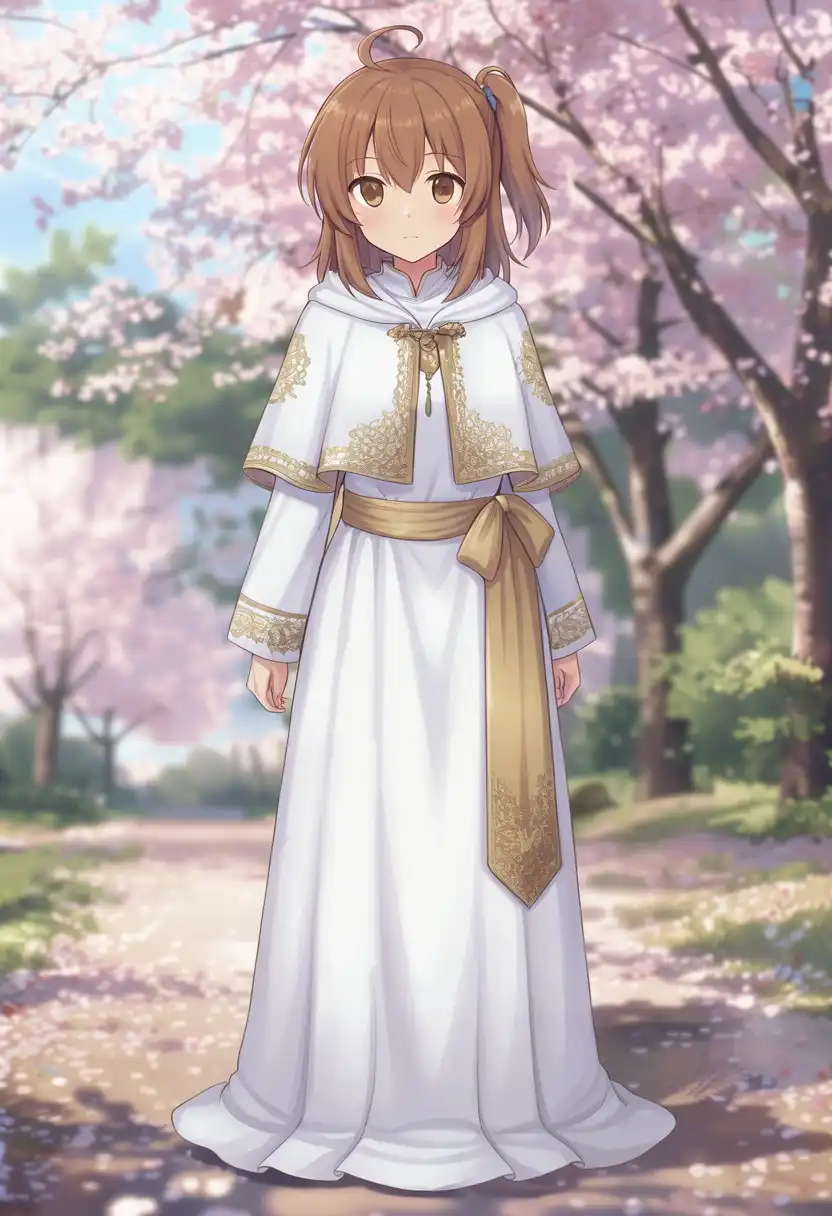
| Model / role | What I saw in the image |
|---|---|
| WAI-Illustrious v160, source image | A circular gold ornament behind a figure in a white robe |
| FLUX 3 Image Klein, edit | The circular ornament became a row of cherry trees and a park path, and the prominent features of the hairstyle and outfit remained |
The edit took 330.60 seconds. The figure’s composition is close to the source, but I did not measure identity at the pixel level. No corresponding Kana-chan LoRA for FLUX 3 was used.
Edit prompt sent to FLUX 3
Convert the reference into a new full-color anime illustration of the same adult woman outdoors beneath cherry blossom trees. Keep her light brown eyes, brown bob hair, high side ponytail tied with a blue ribbon, curled strand above her head, white robe with gold embroidery, short capelet, gold sash, and the same face. Show her head to toe standing on a park path, with cherry blossom trees behind her and soft daylight across the scene. Remove the circular gold ornament from the original background. Keep the character's clothing and hair details recognizable while replacing the background.Editing the Maid Outfit Image
I used the maid-outfit Kana-chan image from the FLUX.2 Klein 4B hands-on test as input. The instruction kept the two-handed heart and changed the white background to a row of cherry trees, at 1024×1024, 16 steps, seed 42. The mflux and iris.c outputs from the past article were not regenerated.

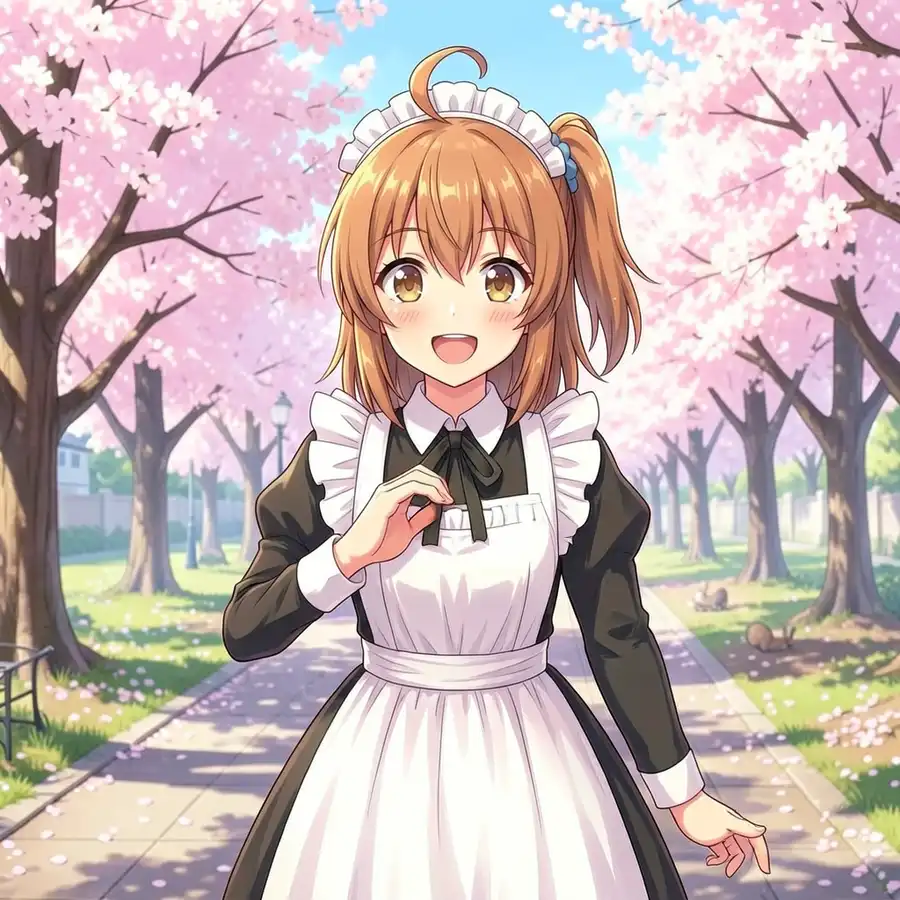
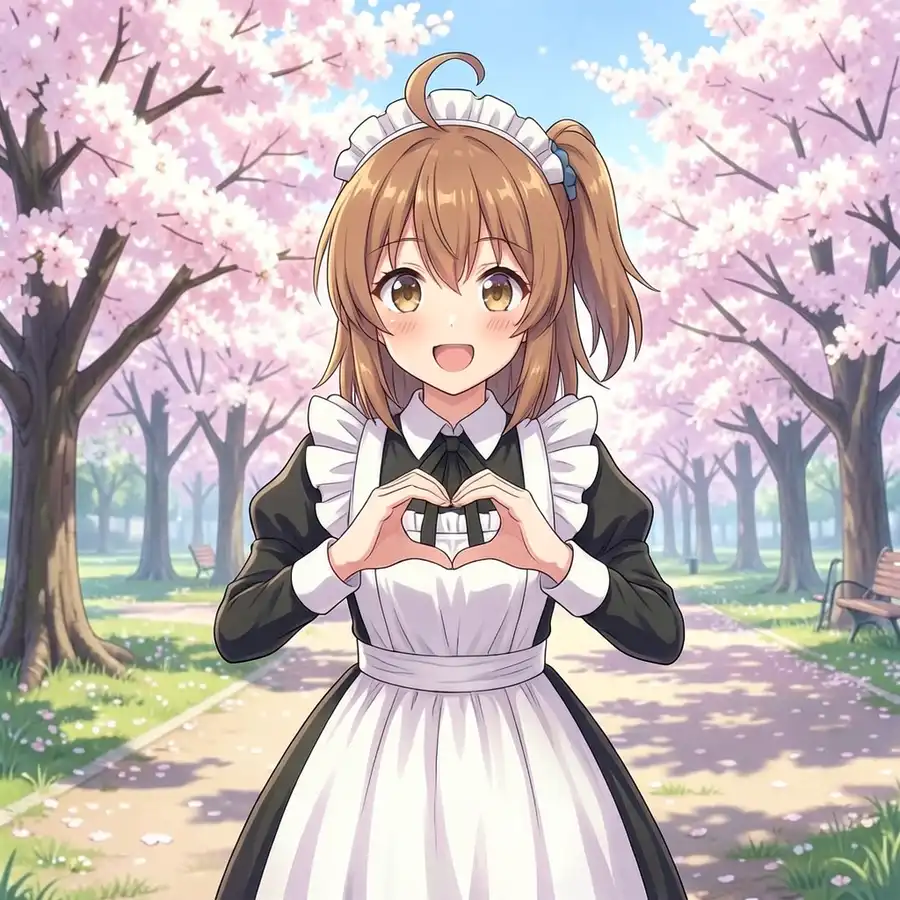
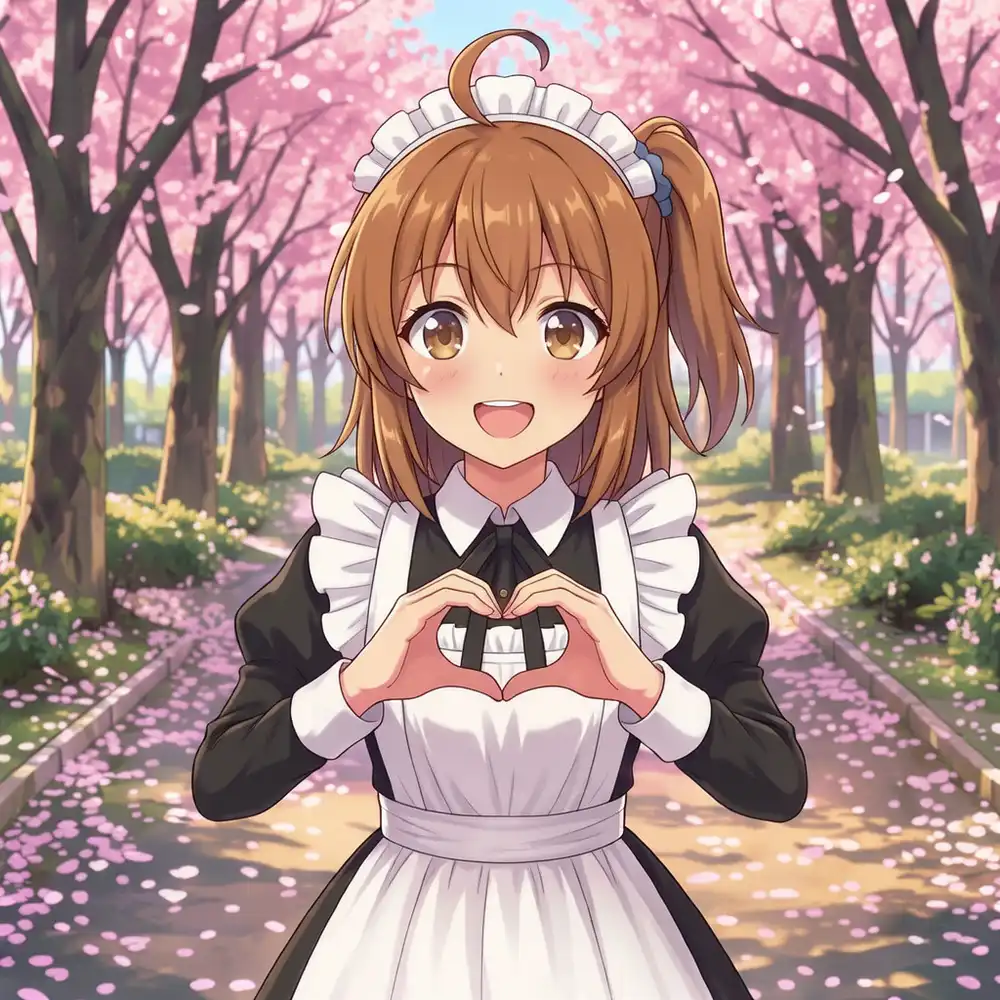
| Model / role | What I saw in the image |
|---|---|
| Input image | White background, maid outfit, two-handed heart |
| FLUX.2 / mflux | Became a row of cherry trees, but the hands of the heart separated |
| FLUX.2 / iris.c | The row of cherry trees and the two-handed heart remained |
| FLUX 3 | The row of cherry trees, side ponytail, maid outfit, and two-handed heart remained |
FLUX 3’s edit took 298.26 seconds. The two older images differ in prompt, implementation, and step count. This single image only shows that the specified hand shape survived.
FLUX.2's short prompt and the edit prompt sent to FLUX 3
FLUX.2: anime girl with side ponytail, maid uniform, standing outdoors in cherry blossom park, anime illustration, kawaii
FLUX 3:
Create a new full-color anime illustration of the same adult woman from the reference image standing outdoors on a path through a cherry blossom park. Keep her brown eyes, light brown bob hair with a high side ponytail tied by a blue band, curled strand above her head, white ruffled maid headband, black long-sleeved maid dress, white apron, and smiling face. Show her from the waist up at the same camera distance. Pink cherry blossoms arch over the path and petals scatter on the ground in soft daylight. Keep both hands raised together in the heart shape shown in the reference, and preserve her clothing details while replacing the plain white background.Layout Control for Text and a Mountain
I also tried the layout control from the model card. The blue word EXPLORE goes at the top of the frame, a blue mountain at the bottom, and the cream background stays. Element names are linked between <id> in the English text and id in the JSON, and boxes are given in 0–1000 coordinates with the origin at the top left. 1024×1024, 16 steps, seed 42.

| Element | What I saw in the image |
|---|---|
| Text | A blue EXPLORE appeared at the top in readable form |
| Mountain | A blue angular mountain appeared in the lower center |
Generation took 157.30 seconds. I converted the specified boxes to 1024px, extracted blue pixels (R<90, G<120, B>70, B>R+25) from the output PNG, and checked their bounding extents. The text was taken from the top 300px and the mountain from below that. This is a simple color-based measurement, not object detection or a positional accuracy evaluation. The official documentation also describes the boxes as guidance for placement and size, not hard masks.
| Element | Specified box in 1024px (top, left, bottom, right) | Bounding extent of blue pixels |
|---|---|---|
EXPLORE | 92, 128, 225, 896 | 99, 138, 221, 893 |
| Mountain | 338, 225, 901, 799 | 350, 238, 901, 786 |
English and JSON sent to FLUX 3
Minimalist graphic poster illustration on a cream paper background <background_1>. The uppercase word <En_Text_1> is centered across the upper part of the poster in dark blue letters. A single angular blue mountain <mountain_1> fills the lower middle section, leaving cream paper visible around its sides. Flat color and a slight printed-paper texture. [{"id":"background_1","bbox":[0,0,1000,1000],"desc":"A flat cream-colored paper surface with a slight printed grain."},{"id":"En_Text_1","bbox":[90,125,220,875],"desc":"The uppercase word \"EXPLORE\" in bold dark blue sans-serif lettering."},{"id":"mountain_1","bbox":[330,220,880,780],"desc":"A single angular mountain silhouette in solid deep blue."}]Generation Time and Memory
FLUX 3 ran in Diffusers at 16 steps, while FLUX.2 Klein 4B in the comparison columns ran at 4 steps with mflux and iris.c in the FLUX.2 Klein 4B hands-on test. The implementations and conditions differ, so the seconds are not a speed difference between the models themselves. Generation time does not include upsampler processing, model loading, or image saving.
| Task | FLUX 3 Image Klein, MPS | FLUX.2 Klein 4B, mflux | FLUX.2 Klein 4B, iris.c |
|---|---|---|---|
| 1024×1024 garden image generation | 168.43 s | 31.7 s | 41.5 s |
| 1024×1024 maid-outfit image edit | 298.26 s | 52.4 s | 86.3 s |
| FLUX 3 condition | Generation time | MPS driver allocation at that point |
|---|---|---|
| Official fox, 1024×1024 | 153.45 s | 27.35GiB |
| BFL fashion photo, reference settings | 162.60 s | 32.85GiB |
| Standing portrait on white, 832×1216 | 153.23 s | 31.56GiB |
| Garden, 1024×1024 | 168.43 s | 31.44GiB |
| 21-year-old indoor photo, smiling | 160.04 s | 31.43GiB |
| Same photo, neutral expression | 160.26 s | 31.43GiB |
| Kana-chan image edit, 832×1216 | 330.60 s | 32.33GiB |
| Maid-outfit image edit, 1024×1024 | 298.26 s | 30.13GiB |
In the first run, the allocation right after loading was 19.61GiB, and the swap usage observed during generation was 0. The memory values in the table are taken after generation, not peak usage. Some conditions were run back to back in the same process, so they cannot be used to compare peaks between conditions. The initial settings used a BF16 VAE and the reference settings used FP32, so that difference also cannot be treated as a same-condition memory comparison.
What This Test Confirmed, by Use Case
| What you want to do | What the images and measurements here support |
|---|---|
| Try FLUX 3’s public weights on a Mac | 1024px t2i and reference-image editing ran on M1 Max 64GB with MPS. Text-to-image generation with the reference settings took about 2.5 to 3 minutes here; the two edits with the initial settings took about 5 minutes |
| Confirm the same picture as the official sample | On this M1 Max, bringing BFL’s upsampled English, seed, noise layout, shift 16, and VAE FP32 in line with the reference settings gave nearly the same person, outfit, and composition as the published sample. The individual effect of each setting is unverified |
| Make standing portraits and dynamic scenes | Natural sentences passed through the official upsampler produced a full-body figure in a white and gold outfit and a running pose with a castle behind. Reproducibility with a corresponding character LoRA is unverified |
| Generate portrait photos | The official full-body sample keeps a similar outfit and background even with a different subject. In face close-ups, some images under window-light conditions had fewer strong reflections, but the smile’s cheek lines remained. Changing only the expression to neutral with the same seed weakened the lines. The facial features still differed from FLUX.2’s |
| Generate 2D anime art in a cherry blossom park | A full-body figure about 7 heads tall and an upper-body image with a larger face were produced from natural sentences. The look changes with face size and art style instructions |
| Change the background while keeping features of the source art | In one image each of Kana-chan and the maid outfit with the initial settings, the background changed while prominent features of hair, outfit, and pose remained. Not rerun with the reference settings |
| Specify the rough position of text and elements | Even with the initial settings, EXPLORE and the mountain appeared within the specified ranges. The boxes guide placement; they are not hard masks |
References
- Black Forest Labs’ announcement post
- Distilled model card and distribution page
- Diffusers implementation introduction
- aiaicreate’s ComfyUI experiment and portrait prompts
- Technical article running FLUX.2 Klein 4B on M1 Max
- Image comparison of WAI-Anima and WAI-Illustrious
NSFW Output Test
From this point on, the test output images may be sensitive, so the images themselves have been blurred. If you want to see the actual results, please try it in your own environment.
I took the waterside seated pose and the front-facing standing pose on white from the April comparison article, rewrote them as natural sentences describing an adult woman, and tried them. FLUX 3 was not given Danbooru tag lists or the literal nsfw tag. Both at 832×1216, 16 steps, seed 42, one image each. The WebP files for the article are blurred over the whole image.


| Condition | What I saw in the image | Time |
|---|---|---|
| Seated by the water | An unclothed adult woman sits at the edge of a forest spring with her feet in the water | 150.94 s |
| Front-facing standing pose on white | An unclothed adult woman stands full-body against a white background | 150.51 s |
The background and pose were also changed, so this is not a test of whether the presence of the word nsfw alone changes the output.
April's original tag lists and the English sent to FLUX 3
Waterside original tag list:
1girl, solo, long blonde hair, blue eyes, completely nude, naked, bare skin, sitting on edge of spring, feet in water, forest, natural light, serene, full body, looking at viewerEnglish sent to FLUX 3:
Full-color anime illustration of one adult woman in her thirties with long blonde hair and blue eyes, completely nude, sitting on the edge of a clear forest spring with her bare feet in the water. Show her full figure from head to feet in a calm seated pose, looking toward the viewer. Trees and stones surround the spring, and soft natural daylight passes through the leaves. The scene uses clean anime linework and soft color shading.White background original tag list:
1girl, solo, long blonde hair, blue eyes, completely nude, naked, bare skin, nsfw, straight-on, full body, standing, white backgroundEnglish sent to FLUX 3:
Full-color anime illustration on a plain white background. One adult woman in her thirties with long blonde hair and blue eyes stands facing directly toward the viewer, shown head to toe in a straight-on full-body pose. She is completely nude, with no clothes or accessories. Her arms rest at her sides and both feet are visible. Use even frontal light, clean anime outlines, and soft shading on a white studio background.