Qwen3.8 restored 625k chars of mangled PDF text; 5 Irodori-TTS workers on one RTX 4090 gave 38h of audio at 13x realtime. Plus an 18x reasoning_effort win and the cuInit 999 check for dead RunPod hosts.
Merged a 4th girl with a makeup toggle into one Anima LoRA (518 images, rank256, 21.5h on RTX 5090). Epoch pick vs design bleed, why makeoff fails in multi-girl prompts, 6/6 one-shot.
Tested over 3 bakes on RunPod RTX 5090: a coined subtractive makeoff tag never fires at cfg 1.0, while additive earrings+makeup tags switch both ways with the face unchanged (ep140).
Fitted Anthropic's jacobian-lens on Qwen3-4B-Instruct-2507 (4090, 51 min, ~1 USD), then read a layer-swapped SFT corrector: outputs pass through while hidden states diverge to cos 0.88.
Tested arXiv 2607.01232's layer localization under SFT: Qwen3-4B depth 25/50/75% vs all-layer LoRA, trained on a RunPod 4090. The eval-loss U-shape is real; the rewrites disagree.
Fine-tuned Qwen3-4B on 799 of my own edit pairs, quantized to a 2.3GB GGUF at 38 tok/s on an M4 mini. Eval loss looked fine, but it barely removed slop — and the real fix was feeding paragraphs, not single sentences.
Merged kei, kana, and koharu into a single Anima (Qwen-DiT) LoRA and ran my first training on Blackwell (RTX 5090, sm_120). Hands-on log: the cu128 / torch2.8 / SDPA stack swap from the 4090, why the weakest character gets absorbed (caption asymmetry, not rank), and how trigger-only prompts separate three close-packed characters at ep143 without ControlNet.
rank128 + 20 two-character images killed the v1 ahoge bleed and body fusion on this Anima dual-character LoRA. Lap-sit stays a Qwen3 text-encoder limit; sweet spot is ep140.
One Anima (Qwen-Image DiT) LoRA, two characters, trained on RunPod: can they touch? Hugs and piggyback hold, lap-sit fuses; stacked limbs survive, interleaved break. Best at ep100, Turbo.
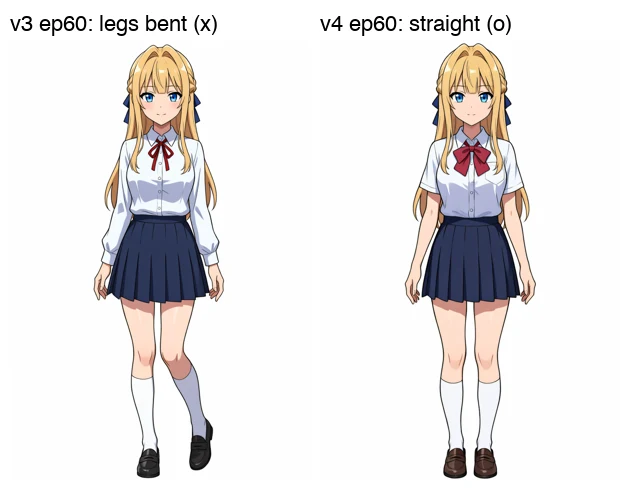
On Anima-Base, my character LoRA bent its legs even on standing. Adding upright references didn't fix it; cutting 36 posed full-body images did. Subtract, don't add.
Rebaked a WAI-Anima character LoRA onto upstream Anima-Base with off-distribution Gemini data. Trigger-only usable, face fidelity beats v1, intakes still cap out.
WAI-Anima LoRA trained only on images the model itself made. Distribution shift drops to ~zero, so the sweet spot hits epoch 20 not 150 (7.5x faster). What the trigger bakes in vs what still needs tags, plus pose/angle control.