One Anima (Qwen-Image DiT) LoRA, two characters, trained on RunPod: can they touch? Hugs and piggyback hold, lap-sit fuses; stacked limbs survive, interleaved break. Best at ep100, Turbo.
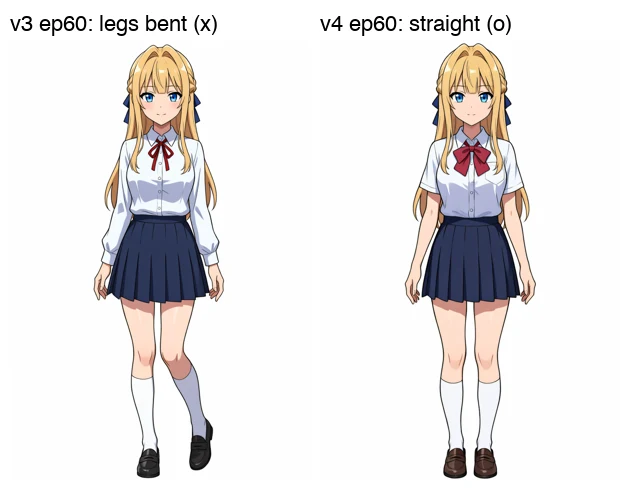
On Anima-Base, my character LoRA bent its legs even on standing. Adding upright references didn't fix it; cutting 36 posed full-body images did. Subtract, don't add.
Rebaked a WAI-Anima character LoRA onto upstream Anima-Base with off-distribution Gemini data. Trigger-only usable, face fidelity beats v1, intakes still cap out.
Tested on M1 Max 64GB ComfyUI: one character LoRA across 6 Anima derivatives, same prompt/seed. Trigger-only never stabilizes, RDBT bolts to beast-ears, structure tags fix it.
Anima is a Cosmos-based DiT, not SDXL, so one Anima LoRA loads on every derivative checkpoint. 20+ CivitAI Anima models sorted by type, aesthetic, and prompt adherence.
Tested on M1 Max ComfyUI: two WAI-Anima character LoRAs in one image. Side-by-side works, but only non-overlapping inpaint keeps the design pixel-exact; Qwen-Image-Edit elongates the side ponytail even with training tags, and overlapping interaction poses jam at skeleton extraction.
WAI-Anima LoRA trained only on images the model itself made. Distribution shift drops to ~zero, so the sweet spot hits epoch 20 not 150 (7.5x faster). What the trigger bakes in vs what still needs tags, plus pose/angle control.
On M1 Max 64GB, SetLatentNoiseMask returns unchanged images with no error. LanPaint alone takes 32 min; adding Crop-and-Stitch drops text inpaint to 2:31.
Tested on M1 Max 64GB ComfyUI: Anima-Base v1.0 matches preview3-base in speed; WAI-Anima kana LoRA hits 22% on light prompts but 67% with hood+robe+embroidery added.
A hands-on log of running Qwen-Scope's Sparse Autoencoder locally on M1 Max 64GB with Qwen3-8B-Base, extracting feature IDs that discriminate between Japanese, English, code, and Chinese from a single middle layer.
The Qwen team released Qwen-Scope, a Sparse Autoencoder suite for Qwen3/Qwen3.5. 14 groups of SAEs covering inference-time steering, evaluation analysis, toxicity classification, data synthesis, and training improvement.