Anima's 4-character LoRA high-fives whoever stands center, not who you name
 Contents
Update (2026-08-14): The follow-up gives each of the 4 girls a different instrument and role in a band scene, and tests Qwen3-14B prompt writing plus an encoder swap → Hand-written 507-token prompt vs Qwen3-14B for an Anima 4-char LoRA band scene
In the previous experiment that trimmed the 4-character LoRA prompt down, writing up to P3 (four girls in a row on a white background) was enough to draw Kurara, Keichan, Kanachan and Koharu distinctly in all 3 seeds. But that was only a lineup of standing figures. A scene where somebody is actually doing something was still untested.
This time I wanted to know how far a single LoRA that locks both the art style and the four girls can go when the prompt also assigns expressions, poses, touching, and foreground/background placement. If it works, I can cut down the extra step of generating characters separately and feeding them into Qwen-Image-Edit or ControlNet.
At first my judging was loose: four girls plus a classroom background counted as success, a raised hand counted as the specified pose. By that counting, images with broken hands, with the wrong girl moving, or with everyone’s face drifting toward Kurara would all pass. I stopped counting unusable images as successes and went back to the P3 that worked last time, changing one sentence at a time.
Four girls on screen doesn’t count as success
I split the pass judgment into 6 items.
| Item | Pass condition |
|---|---|
| Count and identity | Exactly 4 girls, one each of Kurara, Keichan, Kanachan and Koharu |
| Action assignment | Only the specified girl moves; the pose doesn’t spread to anyone else |
| Body and contact | Hands and limbs intact; contact with the floor or furniture isn’t broken |
| Space | Foreground/background, scale, occlusion and landmarks form one continuous scene |
| Readable at a glance | You can tell who is doing what without reading the caption |
| Usable as-is | Works as a finished illustration without retouching details |
An image passes only if it satisfies all 6 items.
Generation settings
| Item | Setting |
|---|---|
| model | anima-base-v1.0.safetensors |
| text encoder | qwen_3_06b_base.safetensors |
| 4-character LoRA | anima-4char-v1_epoch100.safetensors |
| LoRA strength | model 1.0 / clip 1.0 |
| Turbo | none |
| sampler | er_sde / simple |
| steps / cfg | 25 / 4.0 |
| resolution | 1344×768 |
| seed | 42, 1234, 9999 |
As a rule I didn’t edit a prompt after seeing its images within the same condition; only when moving on to the next experiment did I pick a single thing to change and write the condition sheet first.
Expression wording alone changed whose face it was
In a scene with more poses, everyone’s face had drifted vaguely toward Kurara. Not an identical twin, but there were images where only Kanachan’s brown hair and ahoge survived while the facial features turned Kurara-ish.
Without touching actions or the character count, I swapped only the one sentence specifying Kanachan’s expression.
half-lidded eyes, lowered eyebrows and a clearly exasperated expressionI changed it to this.
one cheek puffed out and an exasperated poutThe former directly specifies the shape of the eyes and eyebrows, and under this setup it produced a face close to Kurara’s made-up look. The latter only changes the cheek and mouth, and Kanachan’s face stayed. I also tried adding a small comic sweat drop along the way, but the sweat mark appeared on the girl next to her too, so I dropped it.
Since this is one pair compared across 3 seeds, I can’t pin the cause on this wording alone. Still, specifying eyes, eyebrows and makeup seems to summon a different character from inside the 4-girl LoRA, and sticking to cheeks, mouth and gaze direction left the face intact.
Swapping Koharu and Kanachan in the prompt changed the separation
Next, in the same classroom scene with the desk-touching action removed, I swapped only the order of Koharu’s description and Kanachan’s description inside the prompt. Words, token count and generation settings were unchanged.
| Condition | Character order in the prompt | 4-girl separation |
|---|---|---|
| v40 | Kurara → Keichan → Koharu → Kanachan | 1/3 |
| v41 | Kurara → Keichan → Kanachan → Koharu | 3/3 |
Same content, but which girl’s description comes first changed the output.
Did the order difference come through Qwen or T5?
Anima builds its conditioning by feeding both Qwen’s contextual hidden states and T5’s token sequence into the LLMAdapter. The diagram of this path is in the experiment that examined Qwen and T5 conditioning. So I put v40 and v41 through the same seeds and generated with one condition’s Qwen output combined with the other condition’s T5 output. Below I call this a cross. With both sides on v40, both seeds failed to separate the girls; with both sides on v41, both seeds drew the four girls distinctly and their roles were identifiable. With only one side swapped, it fixed itself or didn’t depending on the seed.
| seed | Qwen v41 / T5 v40 | Qwen v40 / T5 v41 |
|---|---|---|
| 9999 | separation failed | 4 girls separated, placement inaccurate |
| 1234 | 4 girls separated | separation failed |
On seed 9999 swapping only T5 to v41 brought the four girls back; on seed 1234 swapping only Qwen did. Only with both sides aligned on v41 did both seeds return to four distinct girls with identifiable roles.
The Qwen hidden-state shape was [1, 330, 1024] in both conditions, and T5 was 385 tokens in both. Cosine similarity of the flattened hidden states was 0.9118.
The one-side-swapped images also flip results between seeds.
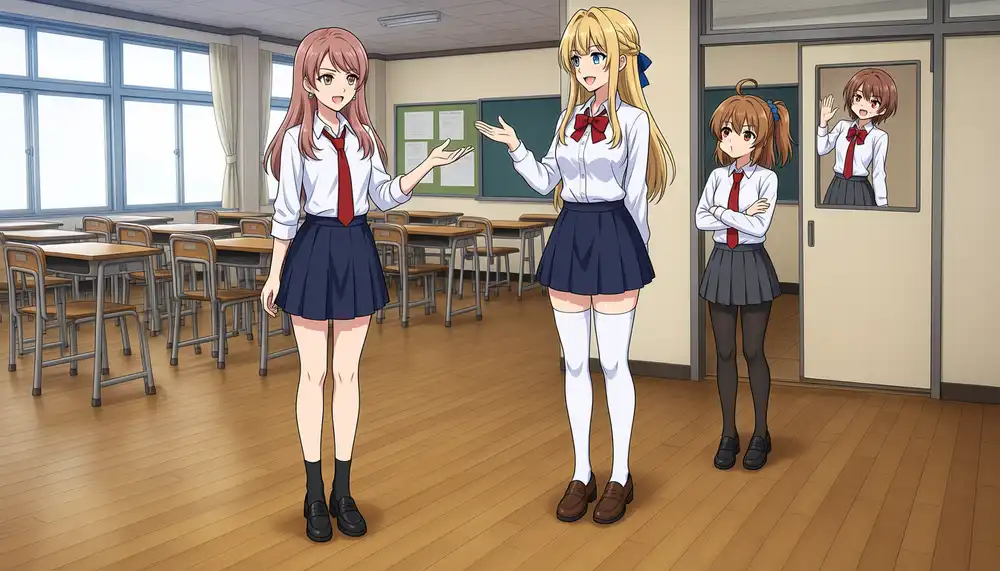
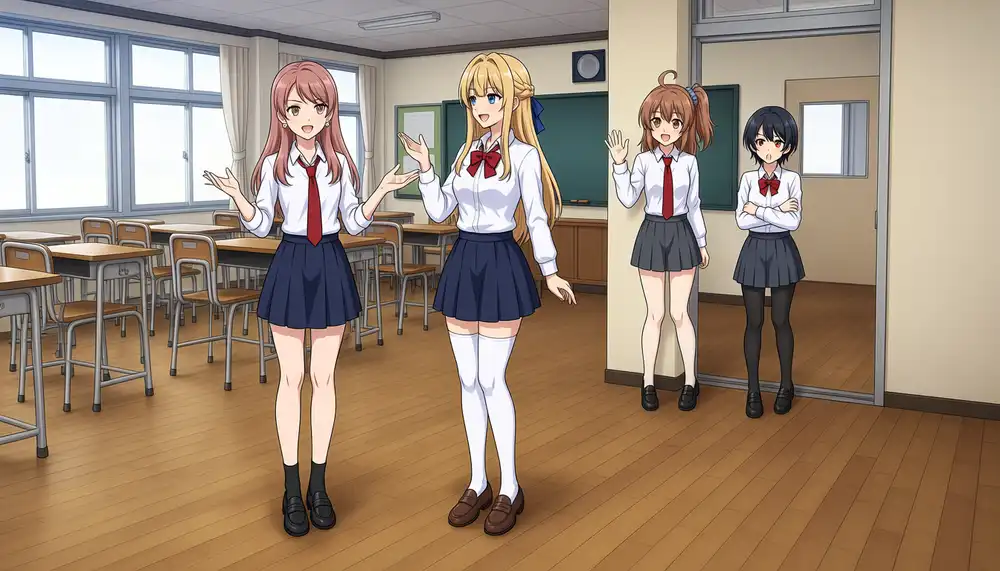
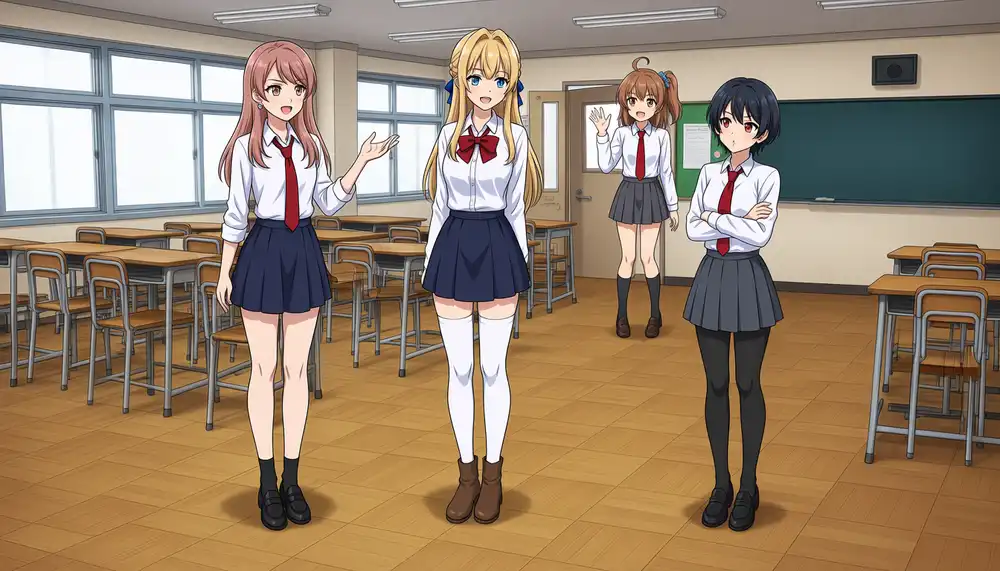
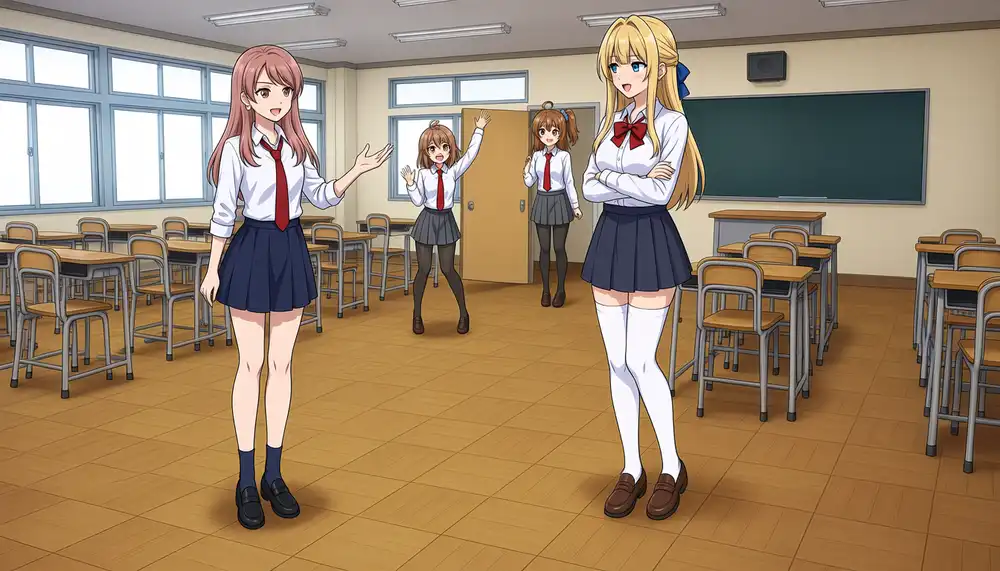
Within this experiment, fixing only one of Qwen or T5 still broke depending on the seed, and only sending the same order through both kept both seeds intact.
Kanachan alone took a pose in all 3 seeds
I dropped the complex scene for a moment and added just one sentence specifying Kanachan’s pose to the previous P3. No other string changed.
She balances on her left foot, bends her right knee backward,
and stretches both arms straight out sideways like an airplane.
In all 3 seeds, only Kanachan stood on her left leg, bent her right knee, and stretched both arms out sideways. Kurara, Keichan and Koharu stayed standing — no drop in character count, no pose spreading, no faces drifting toward Kurara.
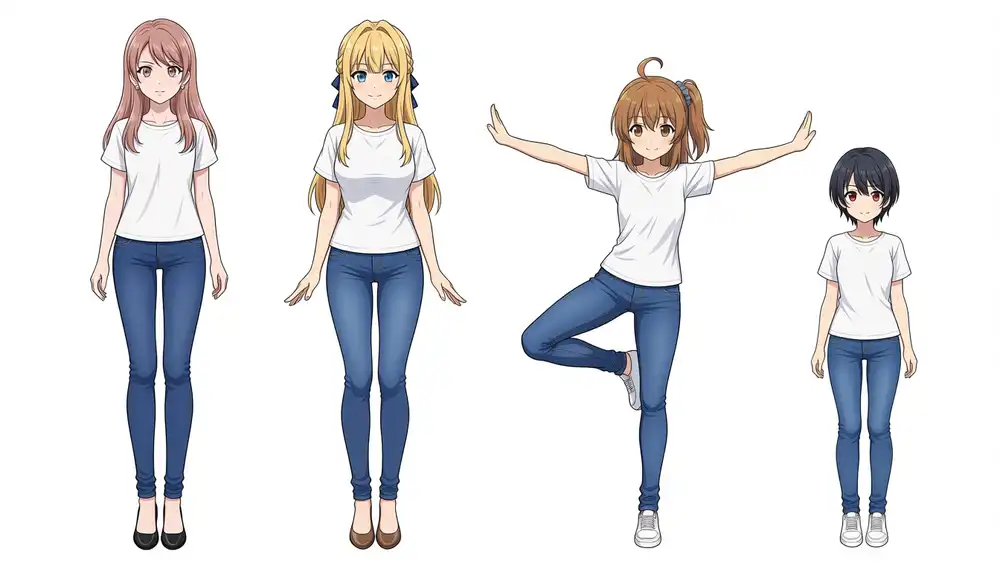
This was only a white-background check that the pose comes through, so it doesn’t count toward the finished-scene judgment. But it did show the 4-girl LoRA can draw a full-body pose for one girl.
Poses touching the floor or a desk cut the success rate
Keeping the v41 character order, I changed one girl’s posture in the classroom.
Both conditions kept the 4-girl separation at 3/3.
| Condition | Specified posture | Remaining problems |
|---|---|---|
| Kurara kneeling on one knee | clear 1/3, ambiguous 1/3, failed 1/3 | whether the knee touches the floor; the conversation partner’s gaze |
| Keichan sitting on the desk edge | 3/3 | mutual gaze clear only 1/3; outfit assignment also unstable |
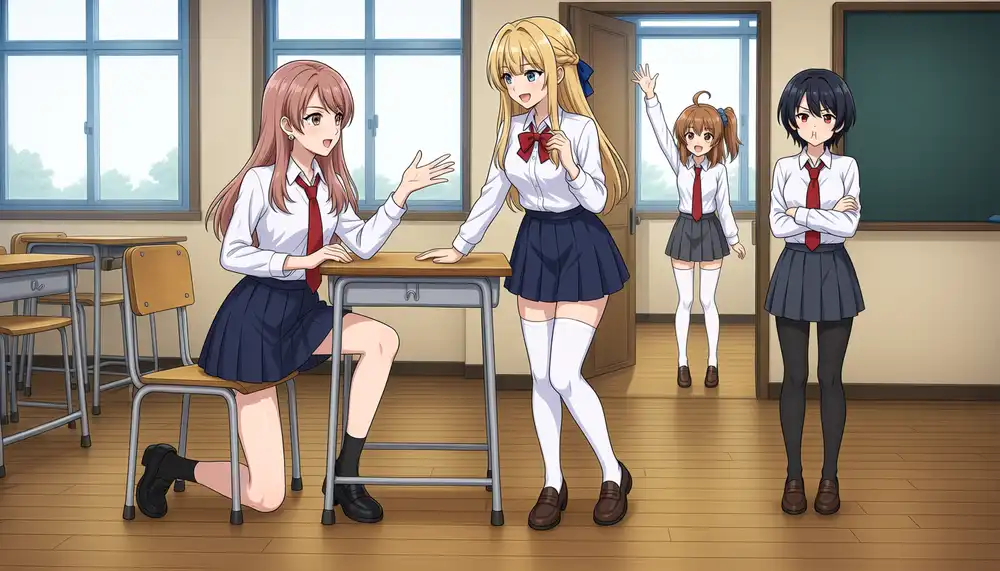
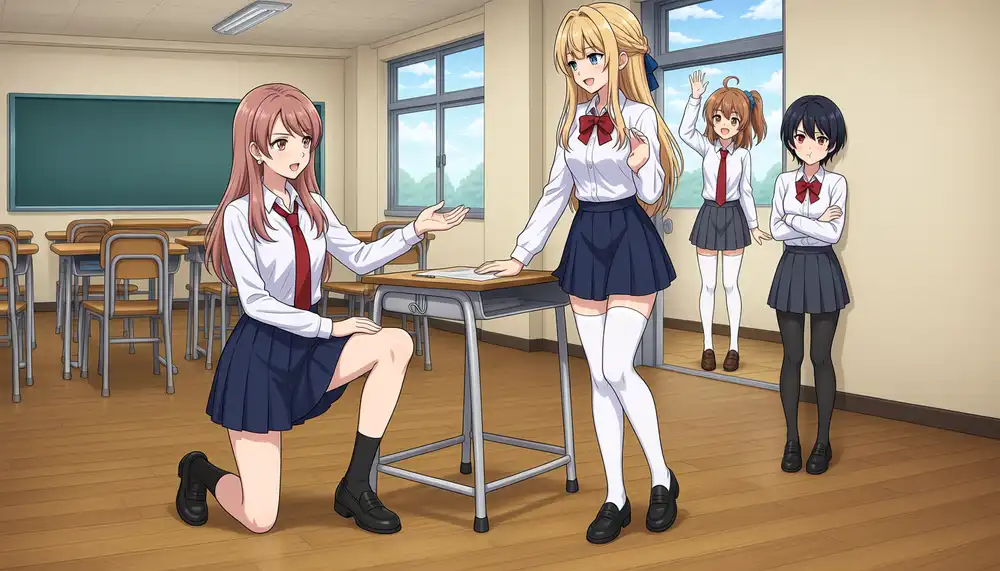
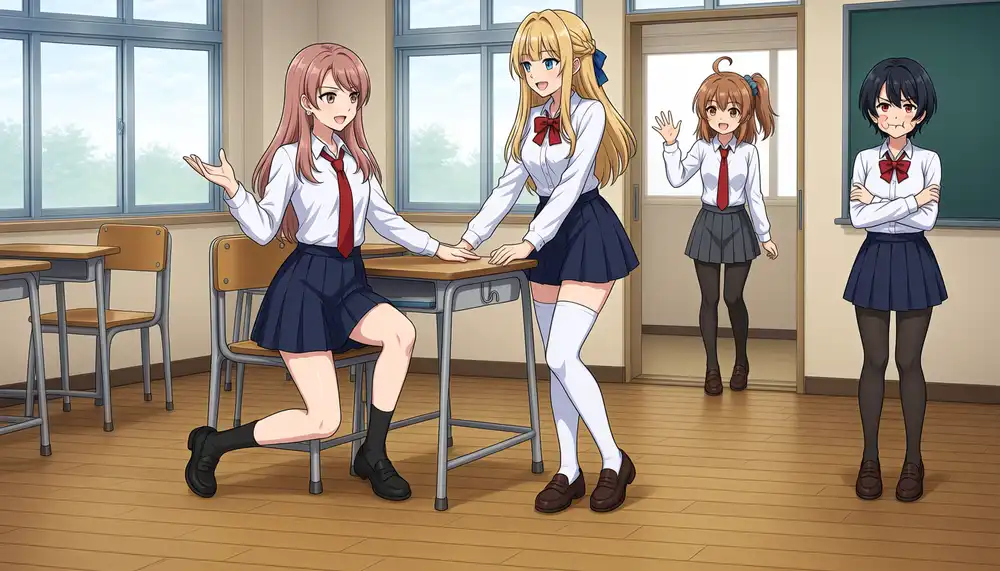
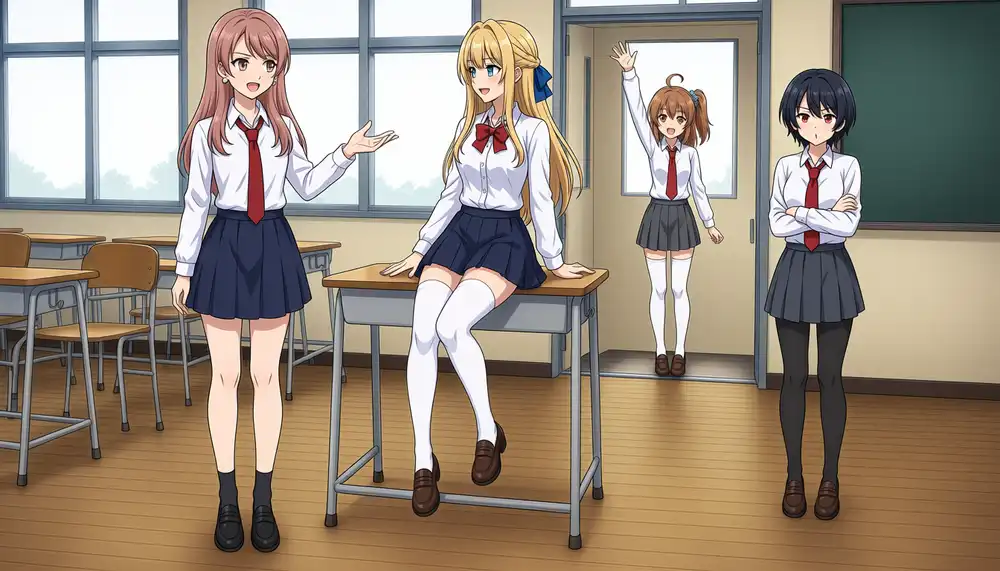
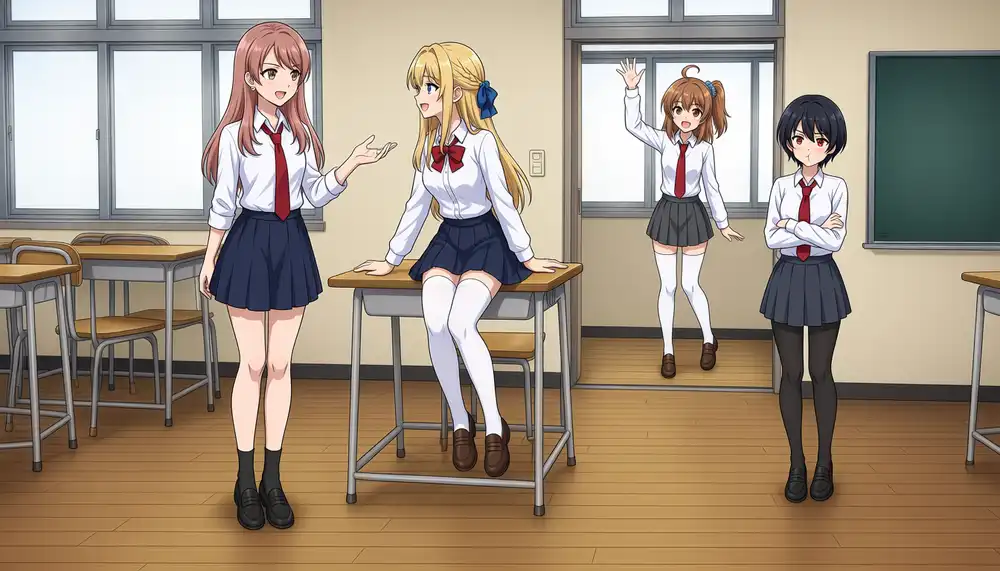
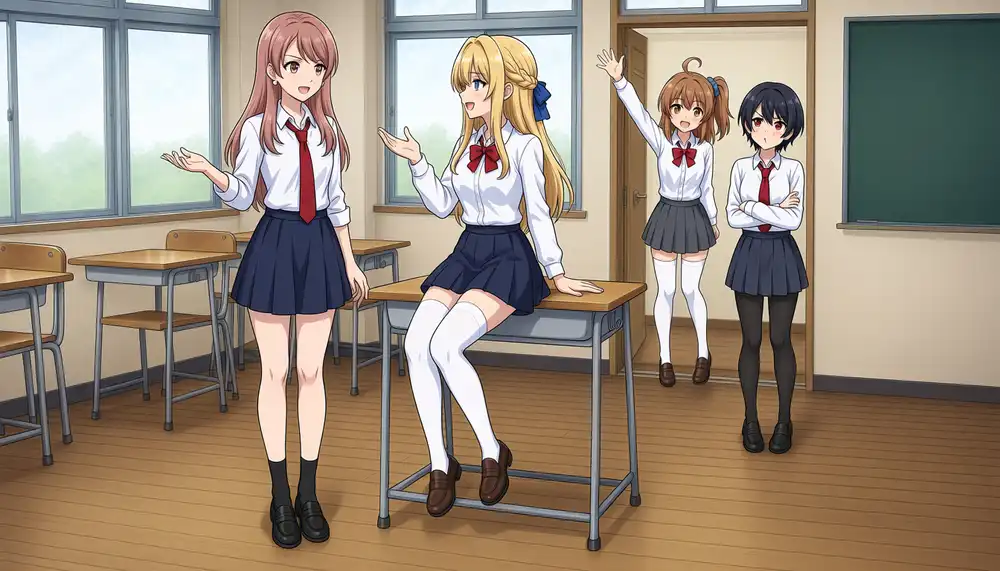
The sit-on-the-desk instruction was roughly obeyed, but front edge, legs hanging freely, and looking at the partner never lined up at the same time. The kneel likewise left it ambiguous whether the knee touched the floor. None of the 6 images is anywhere near perfect.
What differs from P3’s one-leg balance, besides the complexity of the posture, is that the body touches the floor or a desk and that the girl also takes part in a conversation with someone else. When these two demanding conditions stack, the success rate drops.
The high-five went to the center pair, not the named pair
Next I probed with a high-five, where you can clearly judge which two girls touched. I added this to the left two of P3, Kurara and Keichan.
kurara's right open palm and keichan's left open palm touch
above the space between them in one clear high-five.
The 4-girl separation held at 3/3. But in practice the high-five happened between Keichan in slot 2 and Kanachan in slot 3, not the specified pair. On top of that, the free hands linked up until all four girls were holding hands.
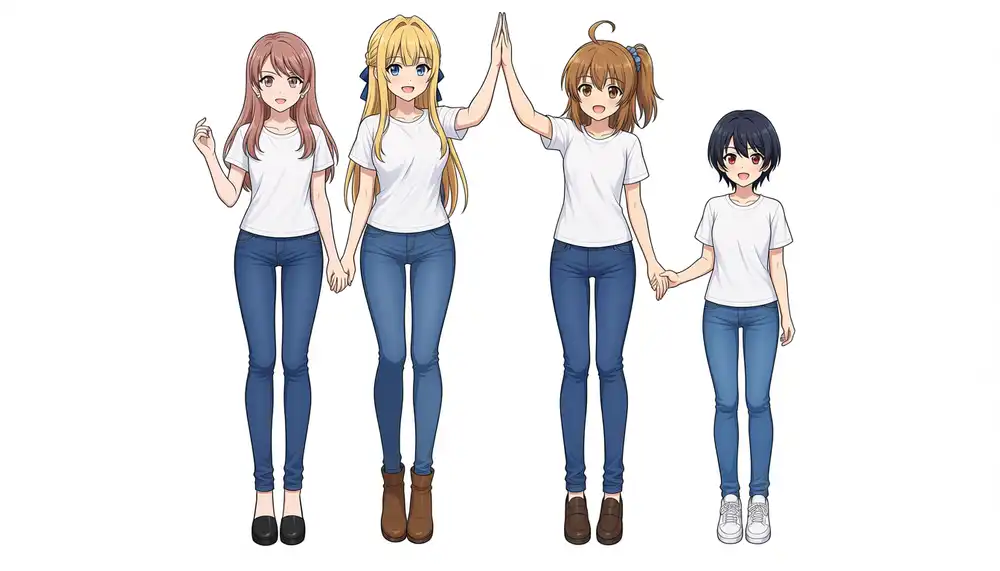
Rewriting Their to the character names still gave the same center pair in 3/3.
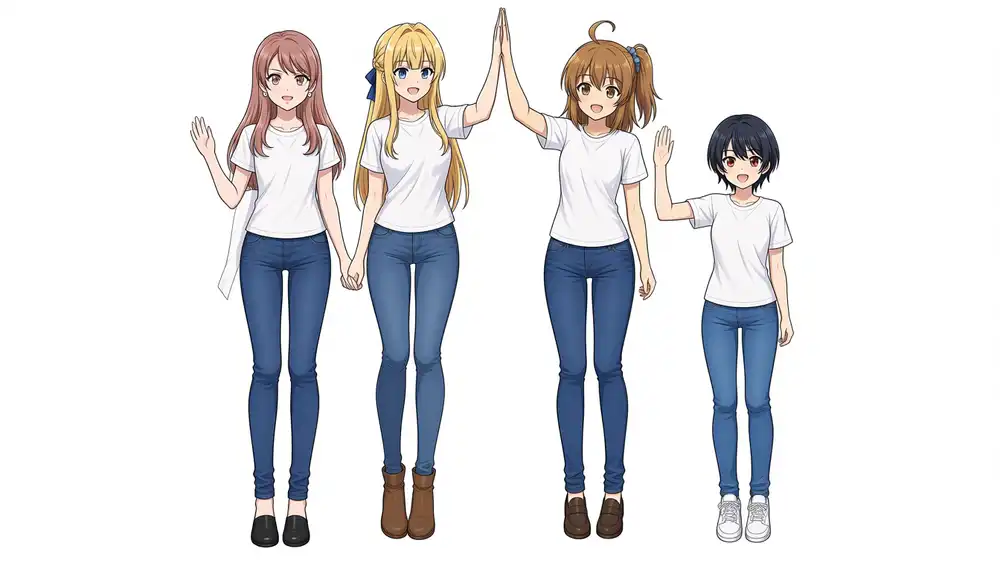
Placing the high-five instruction before the character descriptions made Kurara and Keichan touch on seed 9999 only, though the cast dropped to three girls, while the other two seeds collapsed the center into two blondes.
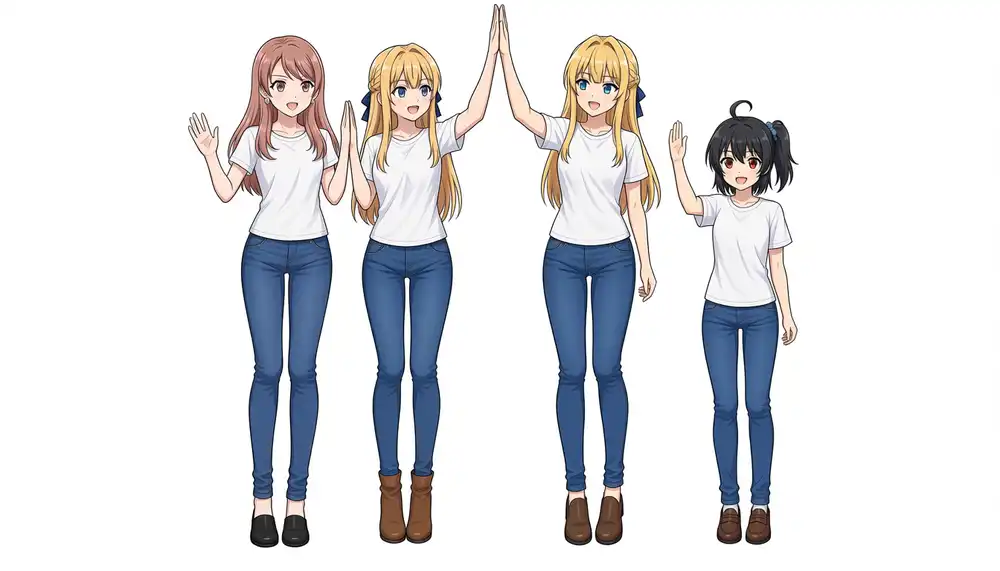
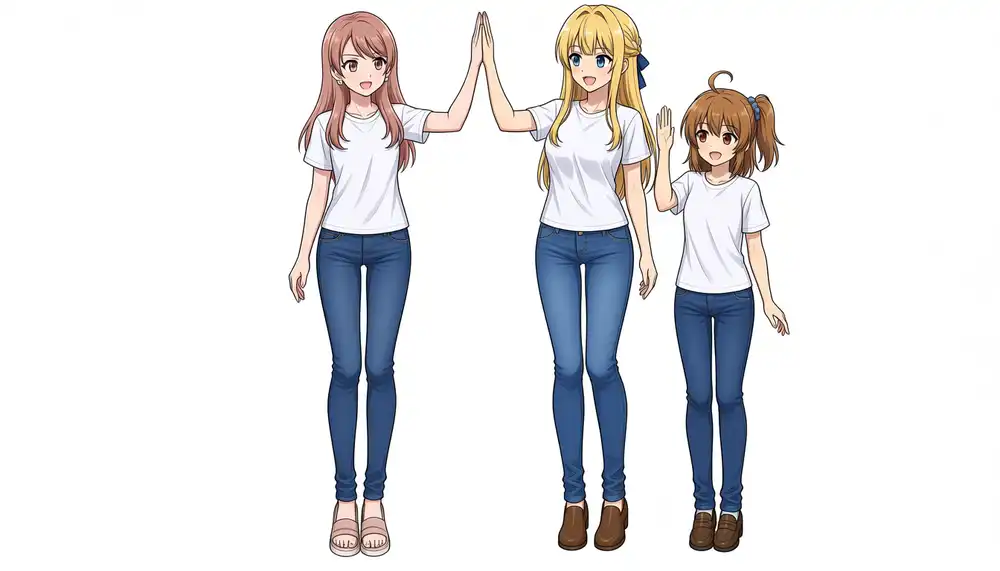
Who touches whom is not decided by names alone. The DiT side’s strong compositional habits, like two girls adjacent at screen center and two slots where symmetric raised arms come easily, seem to take priority over the names.
Putting the pair to touch in the center made all 3 seeds match
I then changed the character order in the prompt to kanachan, kurara, keichan, koharu, placing Kurara and Keichan, the pair I wanted touching, into slots 2 and 3.
First I ran a control without the high-five and confirmed the four girls render in this order.
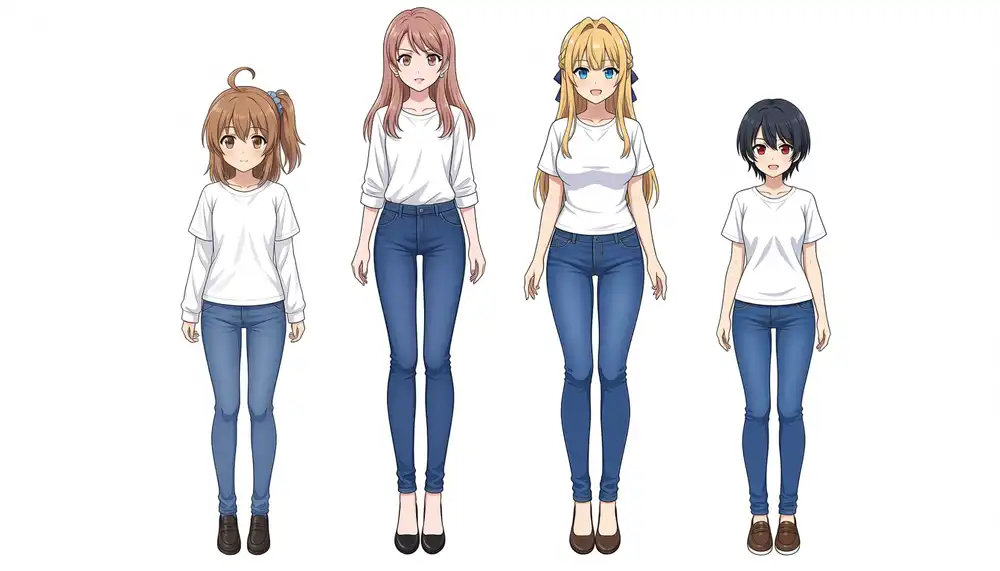
Bringing the high-five back with the same order, all 3 seeds had Kurara and Keichan touching in the center.
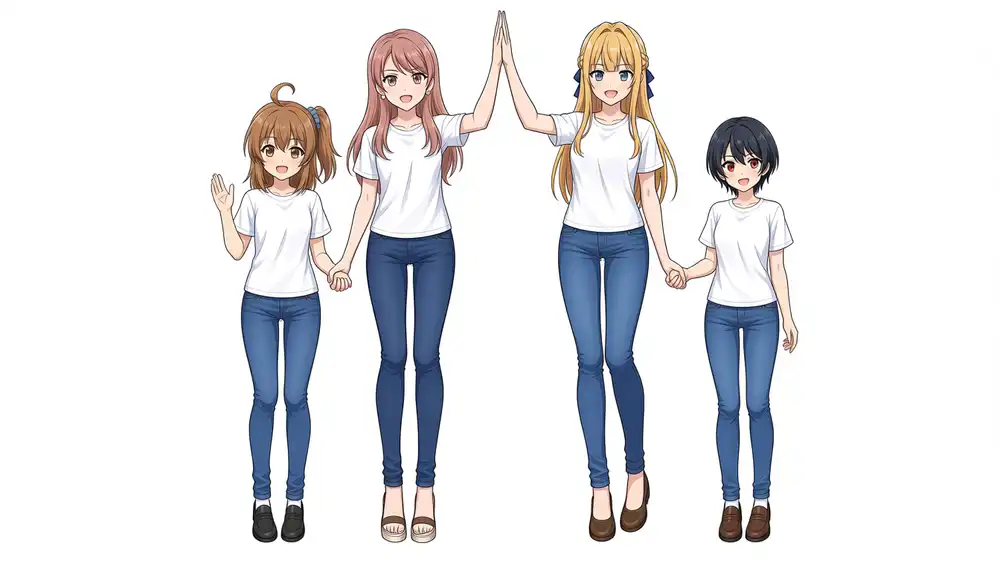
Still, 0/3 images satisfied all 6 items. Seed 42 had all four girls holding hands, and on seeds 1234 and 9999 the uninvolved girls raised their hands too. The specified pair matched, but the high-five as an action spread across the whole frame.
Given this result, the next step was to try placing the pair in the adjacent center slots, and if the action still spread, to write out the foreground/background head counts and the uninvolved girls’ arms to stop it.
Spelling out who is in the foreground and background brought it back to four
In the first v49, which kept the pair centered and moved the scene into a real classroom, seed 1234 gained an extra Kurara for a total of five girls. On seed 9999 even Kanachan in the background raised her hand.
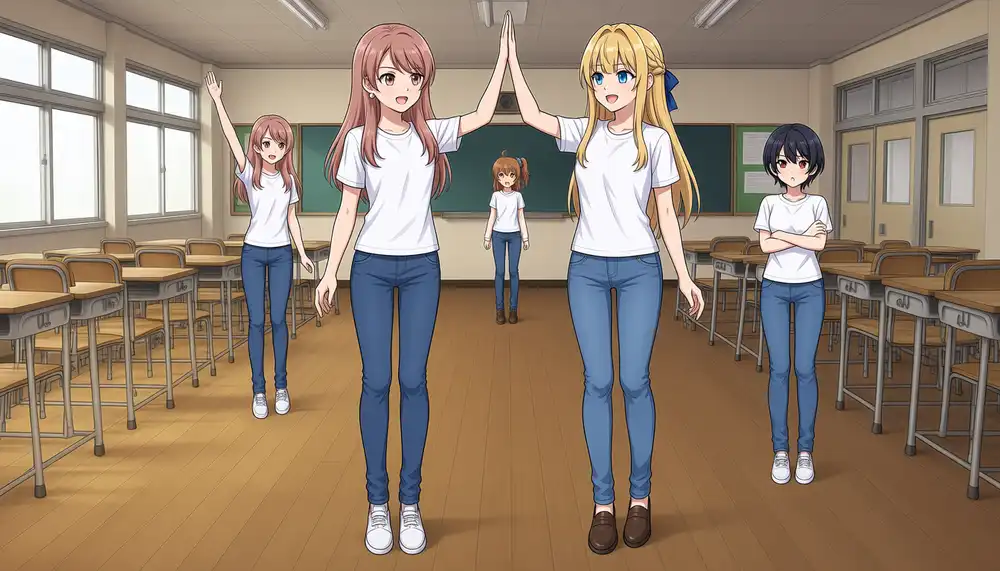
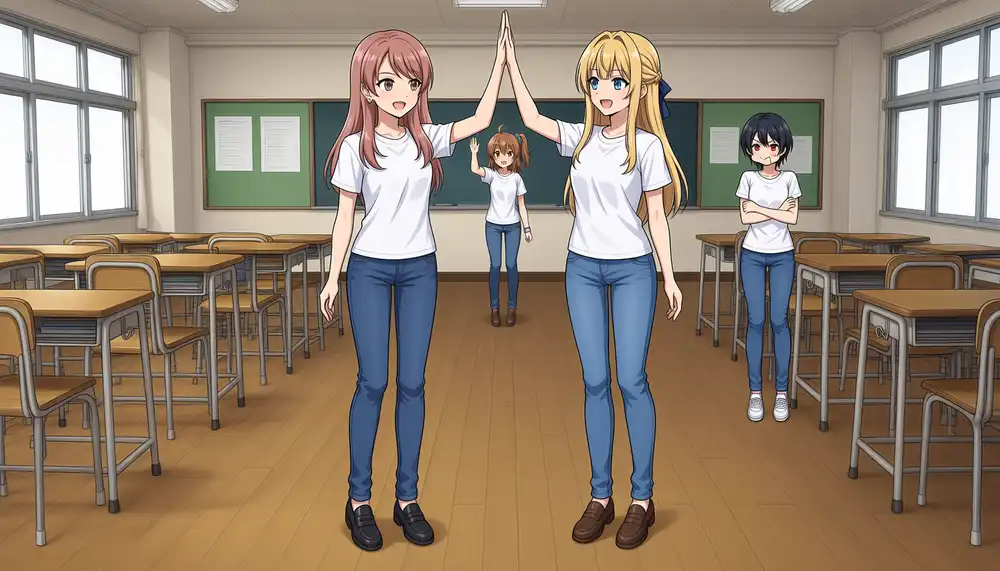
Without changing the actions, I spelled out the head counts and names (three girls in the foreground, one in the background) plus the uninvolved girls’ arms.
Exactly three girls occupy the foreground: kurara, keichan and koharu.
kurara and keichan stand together in the foreground center,
while koharu stands apart on the far right.
Exactly one girl occupies the background: kanachan.

Both of kanachan's arms hang straight down at her sides;
she does not wave, reach or touch anyone.

No other people or duplicate identities are present.
After this change, all 3 seeds had exactly four girls, one each of Kurara, Keichan, Kanachan and Koharu, with Kurara and Keichan high-fiving at the foreground center. Kanachan in the back kept both arms down and out of the high-five, and Koharu on the right had her arms crossed.
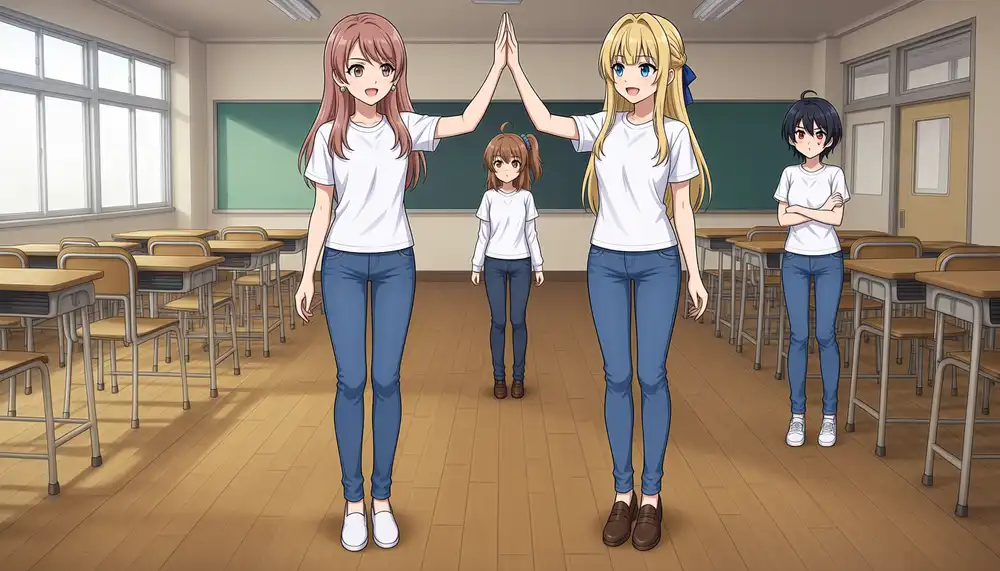
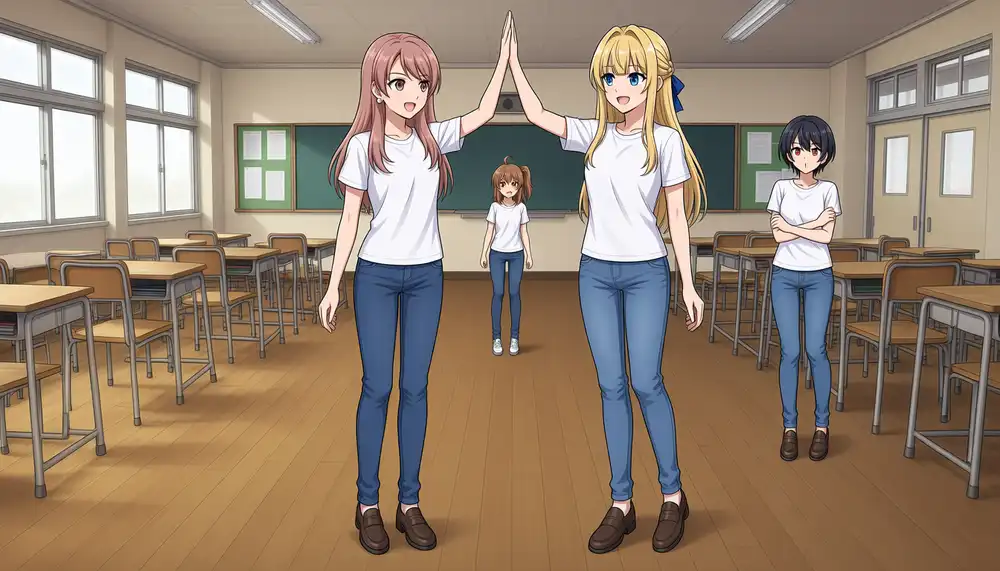
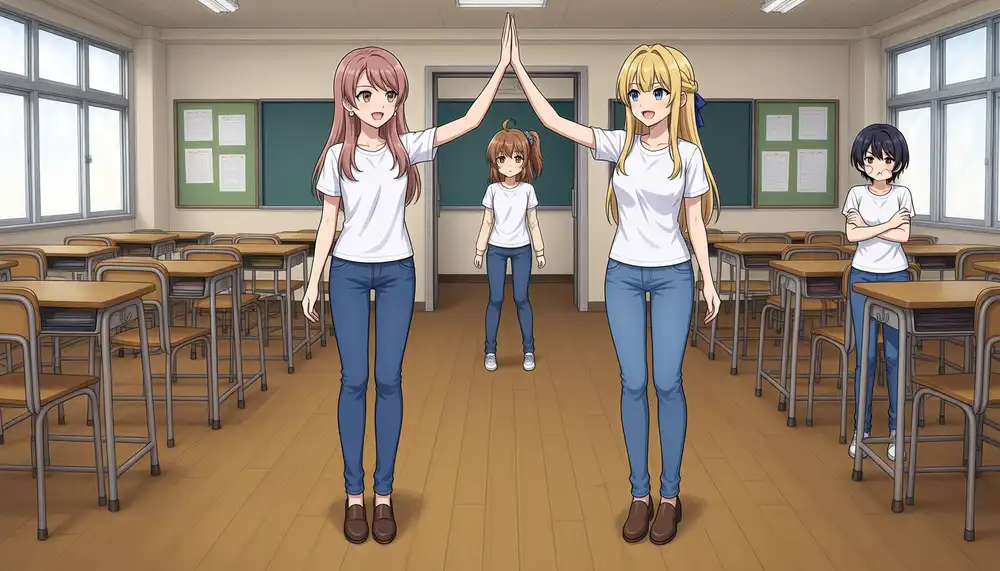
I still scored it 0/3. The stand-in-the-doorway instruction only landed on seed 9999, with Kanachan inside the door frame. But that door is a strange structure that opens onto a wall instead of a corridor, so it doesn’t hold up as a landmark. The classroom itself doesn’t hold up as a background either: the desks face every which way and windows line both side walls. Koharu’s face is also fairly broken, and on seed 42 she even picked up a Kanachan-style ahoge. The roles matched the specification in all 3 seeds, but the background and facial details stayed broken.
The prompt structure that got through to all four
Every condition that just piled on longer text was unstable; structure made the difference, not the amount of information.
Keep each girl’s appearance markers short and fixed, and don’t add or remove hair, eye or accessory details mid-experiment. When changing an expression, leave the eyes and eyebrows alone and work only with cheeks, mouth and gaze. Once the order of the character descriptions is decided, don’t move it, and send the same order through both Qwen and T5. Put the two girls who should touch into the adjacent center slots, and for the foreground and background write not just head counts but the names of who is where. Don’t settle for relaxed on the uninvolved girls either: write out arms down, doesn’t touch, doesn’t wave.
Because this style pins the touching pair to the center, you can’t freely choose where the pair stands. Fine landmarks like doors remain seed-dependent, and the classroom background (window placement, desk orientation) still doesn’t render properly.
Stacking two single-character LoRAs mixes colors and shapes first
In the experiment that stacked Kanachan’s and Keichan’s single-character LoRAs, a simple lineup could keep the hairstyles structurally distinct, but Keichan’s blonde drifted toward brown, and touching poses mixed outfits and identities. That is what pushed me to train two, three and four girls together into a single LoRA.
Of this article’s prompt rules, the head-count and placement writing could also be tried with two stacked single-character LoRAs. But the 4-girl LoRA has been separating the four as distinct triggers since training, while stacked single LoRAs apply independently trained weights to the whole frame at once. So before the prompt even matters, you get the kind of mixing where Keichan’s blonde drifts toward brown.