Artemis II went around the Moon's far side, and Lagrange points feel practical again
 Contents
NASA’s Artemis II looped around the Moon’s far side and set a new record for the farthest distance humans have ever traveled from Earth. The number was 252,760 miles, about 406,800 km, finally beating the mark Apollo 13 set back in 1970.
But the part that stuck with me was not the record itself. It was the way this mission made cislunar logistics feel real again. Orion’s delays, Gateway’s planned orbit, and the old question of where to place infrastructure around the Moon all lead back to the same concept: Lagrange points.
Artemis II was a full-up rehearsal for a crewed lunar round trip
Artemis II is not a lunar landing mission. It is “just” a lunar flyby and return. But in practice it is the mission that tests whether a crewed round trip to the Moon actually works as an operation.
While passing behind the Moon, the crew had to deal with a temporary communications blackout, observe the lunar surface through Orion’s windows, and run through the full chain of attitude control, onboard life support, and return procedures. Before the next crewed landing attempt, NASA has to prove this part first.
The crew is:
| Crew member | Role | Note |
|---|---|---|
| Reid Wiseman | Commander | Long-duration ISS veteran |
| Victor Glover | Pilot | First Black astronaut to fly a lunar mission |
| Christina Koch | Mission Specialist | First woman assigned to a lunar mission |
| Jeremy Hansen | Mission Specialist | First non-American astronaut to head for the Moon |
The mission flow looked roughly like this.
graph TD
    A["Day 1<br/>Launch from Florida<br/>Injection into Earth orbit"] --> B["Day 2<br/>Burn toward the Moon<br/>Enter free-return trajectory"]
    B --> C["Day 3<br/>Course correction<br/>Handle onboard hardware trouble"]
    C --> D["Day 4-5<br/>System checks<br/>Evaluate suits and habitability"]
    D --> E["Day 6<br/>Lunar flyby<br/>Pass behind the Moon<br/>Set new human distance record"]
    E --> F["Day 7-9<br/>Return toward Earth"]
    F --> G["Day 10<br/>Planned splashdown in the Pacific"]
The far-side pass is easy to romanticize, but the actual concerns are very practical. What happens when communications drop out, how well the spacecraft supports the crew over a long flight, and whether the heat shield really survives reentry. Artemis II is checking those one by one.
The delays were not glamorous at all
The reasons Artemis II slipped so far were also exactly the kind of unglamorous problems big space programs always run into.
Artemis I exposed unexpected wear on Orion’s heat shield. Some of the material ablated in ways NASA did not expect, so the agency pulled samples and reworked its analysis. Artemis II did not get a brand-new heat shield design from scratch. Instead, NASA adjusted the reentry profile to avoid the worst conditions. In other words, the real verdict only comes after this mission finishes its return safely.
There was also a liquid hydrogen leak before launch, at essentially the same kind of interface that caused trouble during Artemis I. Then the upper stage showed abnormal helium flow and the rocket had to go back into the Vehicle Assembly Building for more work. Lunar exploration sounds futuristic, but what actually stops the schedule can still be pipes, valves, and connection hardware.
Even after launch, Orion had restroom-system trouble. A pump and waste line used for urine handling malfunctioned, forcing the crew to use backup procedures. These details often get brushed aside in space coverage, but on a ten-day crewed mission they matter a lot. Propulsion, communications, power, and basic human habitability all sit on the same level.
This is less Apollo than the first step toward cislunar traffic management
The big difference from Apollo is that the objective is no longer just “reach the Moon once.” The goal now is to build something that can support continued activity around the Moon.
| Item | Apollo | Artemis |
|---|---|---|
| Goal | Reach the Moon first | Build lasting footholds in cislunar space |
| Power | Fuel cells | Solar power |
| Structure | Mostly US-only | NASA, ESA, CSA, and commercial partners |
| Operating model | Short, self-contained campaign | Sustained operations with docking and resupply |
Apollo was incredibly effective as a Cold War program, but it was heavy and hard to sustain. Artemis is slower, but it starts with a distributed structure that includes Europe, Canada, and commercial landers. Once the program is about sustained operations, the question is no longer only how to land. It is also where to put the infrastructure between Earth and the lunar surface, and on the far side.
That is where Lagrange points stop being textbook vocabulary and start becoming operationally relevant.
There are five useful markers in the Earth-Moon system
A Lagrange point is a place in a two-body system such as Earth and the Moon where gravity and rotation combine in a way that makes the region useful for spacecraft placement. It is better to think of them as good reference locations, or gateways into useful surrounding orbits, than as magical points where things simply sit still forever.
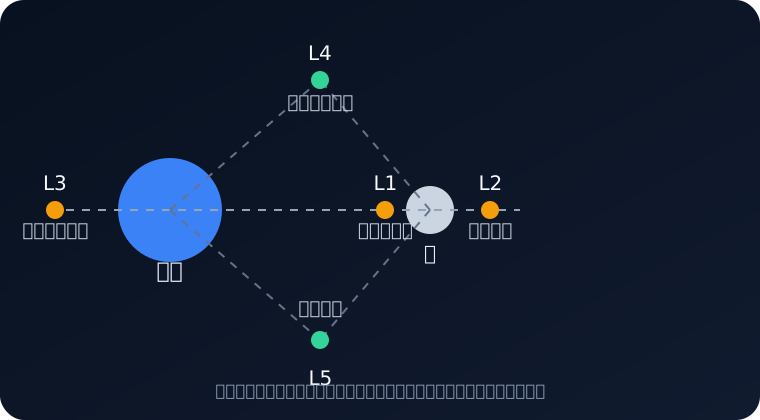
A schematic layout of the Earth-Moon Lagrange points. L1 and L2 lie on the Earth-Moon line, while L4 and L5 sit at the vertices of an equilateral triangle. Distances are not drawn to scale; positions are adjusted for readability.
| Point | Location | Practical use |
|---|---|---|
| L1 | Between Earth and Moon | Transit point, reference for cislunar outposts |
| L2 | Beyond the Moon | Far-side support, deep-space side, communications relay |
| L3 | Opposite side of Earth | Little practical value |
| L4 | Ahead of the Moon in its orbit | Comparatively stable |
| L5 | Behind the Moon in its orbit | Comparatively stable |
L1 and L2 are easy to picture because they sit on a straight line. They also map neatly onto the idea of traffic nodes between Earth and the Moon. L4 and L5 form equilateral-triangle positions with Earth and the Moon, which is why they are the “stable-looking” ones in every diagram.
This is also where the connection to “the three-body problem” needs a qualifier. What appears here is not the full chaotic problem of three massive bodies all pulling on one another the way the title Three-Body makes people imagine it. In the Lagrange-point story, Earth and Moon are the main masses, and the third object is treated as very small. So this is really the restricted three-body problem, and Lagrange points are special solutions inside that limited case.
L1 and L2 are where lunar infrastructure starts to make sense
For lunar operations, the most important places are around L1 and L2. Gateway, the outpost NASA wants to build near the Moon, is designed around exactly this kind of orbital mechanics.
Gateway is planned for NRHO, the Near Rectilinear Halo Orbit, which takes advantage of the dynamics near the Moon’s L1 and L2 regions. That orbit makes it easier to access the surface while keeping station-keeping costs reasonable. It reflects a shift from direct-out-and-back missions toward a model with an actual foothold in cislunar space.
The most famous L2 occupant today is not in the Earth-Moon system but in the Sun-Earth system: the James Webb Space Telescope. That is a different system, but the logic is similar. L2 is useful when you want major heat and light sources grouped into one direction. For lunar operations, the same general idea makes the far side and deep-space side easier to support.
And yes, far-side communications can absolutely be handled with lunar-orbit relay satellites. In fact, you can build a relay network that way. The problem is persistence. A single low lunar orbiter will eventually pass behind the Moon from Earth’s point of view and lose line of sight itself. If you want a steadier bridge between Earth and a far-side outpost, higher orbits or L2-adjacent trajectories make more sense. That is why L2 shows up so often in relay discussions.
In the equations, L1 to L3 are slippery and L4 to L5 are sticky
This is where the math helps. The short version is simple: L1, L2, and L3 tend to throw things away when perturbed, while L4 and L5 tend to keep things nearby because of rotation effects.
The motion of a tiny third body around two large bodies can be written as the restricted three-body problem. In a rotating coordinate system that co-rotates with the two main bodies, the effective potential is:
Lagrange points are the places where the gradient of that effective potential becomes zero:
L1, L2, and L3 are the collinear solutions. Solving for them exactly leads to a fifth-degree equation. If you write the mass ratio as , a common approximation for L1 is:
In the Sun-Earth system, this is why L1 and L2 end up about 1.5 million km from Earth. More important than the number is the behavior: these points are unstable. They are like a ball perched on a ridge. Push it a little, and it keeps drifting away.
L4 and L5 are different because the Coriolis force becomes part of the story:
Instead of simply running away, a perturbed object gets deflected sideways and tends to circulate around the point. The stability only holds below a certain mass-ratio limit, usually written as the Routh criterion:
The Sun-Earth and Sun-Jupiter systems both satisfy that easily, which is why Trojan asteroids can sit around L4 and L5 for very long times. They are the classic real-world example.
Gundam is still one of the quickest ways to make the distances feel real
For Japanese readers, Gundam is probably still the fastest way to make the layout of Lagrange points feel intuitive. In the Universal Century setting, the Side colonies are placed near Earth-Moon Lagrange points.
| Side | Approximate placement | Narrative role |
|---|---|---|
| Side 1 | Near L5 | Federation-leaning civilian sphere |
| Side 6, including Izuma Colony | Near L4 | Neutral zone, relevant to GQuuuuuuX |
| Side 3 | Near L2 | Home sphere of the Principality of Zeon |
| Side 7 | Near L1 | Starting point of the original Gundam |
Side 3 being near L2 has always made immediate sense. It sits on the far side of the Moon from Earth’s perspective, which gives it political and psychological distance. That works well for an independence-minded power center.
L4 should not be treated as background decoration either. Once you think of Side 6, and by extension Izuma Colony in GQuuuuuuX, as an L4-side habitat, L4 stops feeling like a line in a mechanics textbook and starts to feel like an actual place where people live.
In real spaceflight, L2 hosts telescopes and L1/L2-adjacent orbits show up as outpost candidates. Fiction and reality use them differently, but both end up circling the same question: if people and hardware are going to move around the Moon on a routine basis, where do you place the useful footholds?
That is what makes Artemis II interesting to me. The record matters, but the more important shift is that the conversation has moved back from “achievement” to “infrastructure.” L1 and L2 are showing up again not as abstract terms, but as places where real plans want to put things.